The Army’s rising stars gathered at Picatinny Arsenal in New Jersey to ideate potential solutions for the future of warfare.
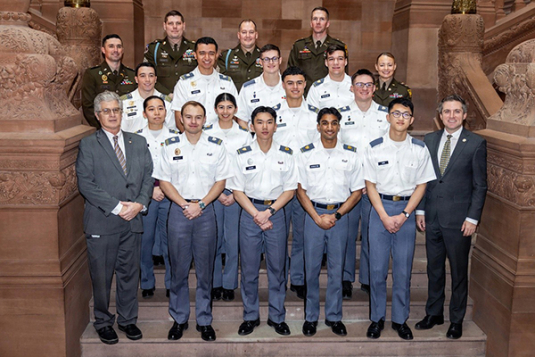
28 cadets from the United States Military Academy were brought in for a day-long roundtable to discuss the best ways for the Army to prepare for technological advances and emerging warfighting concepts.
The cadets themselves, most of whom were firsties, were eager to share their thoughts on how the Army can best modernize and refine its warfighting concepts. According to CPT Travis Chewning-Kulick ’17, an instructor in USMA’s Department of Mechanical and Aerospace Engineering, each cadet was enrolled in the Academy’s weapons engineering program.
“Being a mechanical engineer, and with what we learn at West Point, in addition to the training we have, we have an opportunity (while at Picatinny) to see things from the military side,” said CDT Kiran Goldstein ’26. “We’ve done the training to understand the technology and how it could best be implemented into a wider area.”
“We learn all the theoretical concepts in class and perform analysis on them. Just seeing how that analysis gets used in the real production and actual improvements on weapon systems, and any new technologies and capabilities that the Army is able to produce, is definitely exciting,” added CDT Ty Ezell ’26.
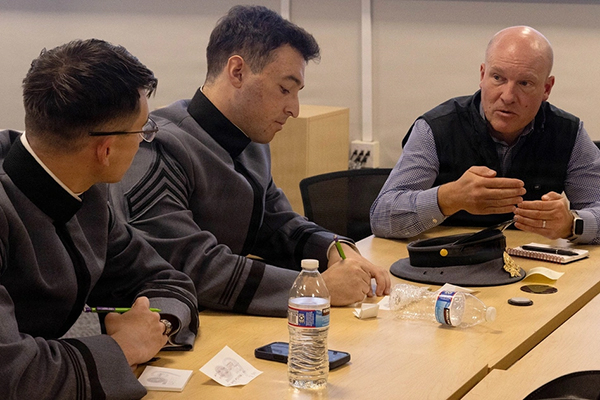
U.S Army Combat Capabilities Development Command (DEVCOM) Armament Center Director Chris Grassano encouraged the cadets to be ready, as the Army is amidst what he called a “great big transformation.” He pressed the cadets to consider every facet, from production to affordability, and to reach into every pocket of knowledge they had while they brainstormed.
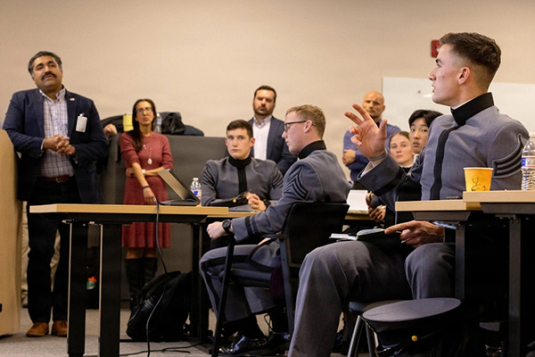
The cadets received briefings covering a range of topics, including future threats, technologies, and operational concepts. They then split into four groups led by Armaments Center experts in emerging technology areas: autonomy/artificial intelligence, contested logistics, counter-unmanned aerial systems, and lethal unmanned aerial systems.
Working with the experts, cadets formulated 120 different ideas and strategies that will be reviewed by organizations within the Armaments Center, according to Lisa Sassaman, a data scientist from within the G9 Innovation and Strategic Relationships Office, who planned and facilitated the ideation sessions with cadets.
The ideas will also be used to refine the Future of Armaments study, which identifies and prioritizes necessary armaments and lethality capabilities needed to achieve battlefield overmatch in future conflicts, according to Sassaman.
“The idea of how we sustain the battlefield is completely altering within the new scope of warfare, as we see in wars around the world,” said CDT Justin Zetterwall ’27. “To be able to learn and take away as a young officer in the future of our United States Army, I think it’s very important.”
The cadets were taken on a tour of several major facilities, where they had the chance to see some of Picatinny Arsenal’s inner workings. After the event, they were tasked with providing a one-page recap of their topics.
According to Nathaniel Helminiak, Associate Director of Armaments for the Center for Applied Engineering within the Department of Mechanical and Aerospace Engineering, he and USMA greatly benefited from the session.
“I believe this event was highly valuable in exposing our cadets to aspects of weapons engineering and design that extend beyond the typical academic curriculum,” Helminiak said in an email after the session. “The event provided them with direct access to subject-matter experts and helped contextualize the critical role the Armaments Center plays in supporting the warfighter and safeguarding our future.”
“Engaging USMA cadets provided fresh perspectives and creative solutions to address emerging challenges,” Sassaman said afterwards. “This event highlighted the importance of engaging future Army leaders in ideation to drive concept-driven transformation and modernization.”
The excerpt and image were taken from https://www.dvidshub.net.