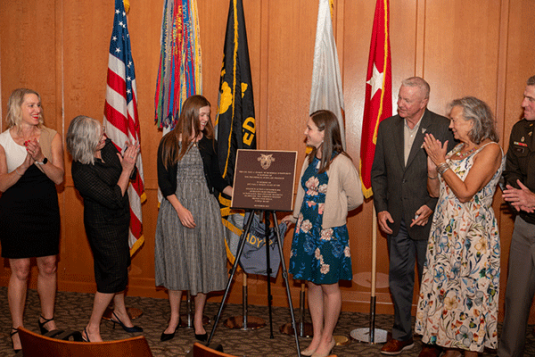

Philanthropy as Leadership
“It’s amazing what you can accomplish when you don’t care who gets the credit.” For Tony Guzzi ’86, that well-known principle is more than a quote, it is the throughline of his leadership, his philanthropy, and his enduring commitment to West Point.
As Chairman and CEO of EMCOR Group, Guzzi has led one of the nation’s largest specialty construction and facilities services firms for more than two decades. But long before taking the helm of the boardroom, he was a cadet, an experience he credits with “shaping the core of who I am,” he says. “There is nowhere I would rather have been. I came in with strong values. The Academy refined them.”
As an infantry officer during the post-Cold War drawdown, Guzzi and his classmates watched the Army shrink dramatically. After earning admission to Harvard Business School, he transitioned from active duty and built his career in business, eventually rising to lead EMCOR. In the early 2000s, he and his family moved to Fairfield, Connecticut, close enough to return regularly to West Point. The renewed proximity made the Academy less of a memory and more of an active presence in his life and helped to reinforce his conviction that its mission mattered deeply to the nation.
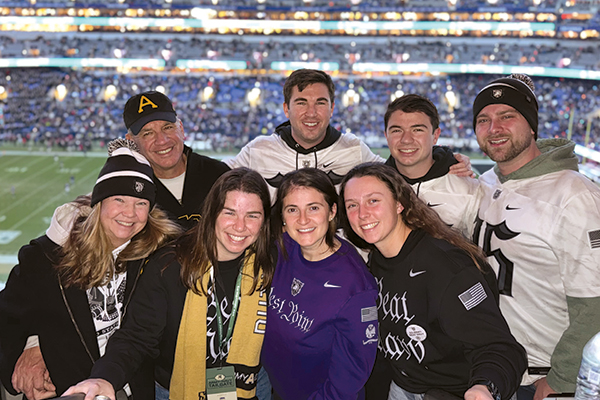
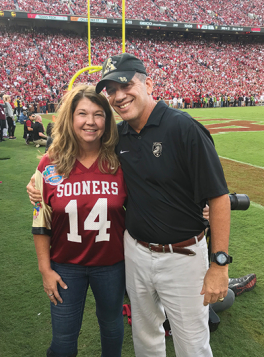
“We started coming to more games,” he recalls. “I’ve always been a big football fan. I have always loved the Army team.”
Though he walked on the football team as a cadet and was cut early in his plebe year, athletics were not central to his West Point experience; academics and military leadership were his primary focus. However, returning to Michie with his family deepened his connection to Army athletics in an entirely new way. The march on, the flyover, the Parachute Team, the overall energy, and now the competitiveness of the team drew them back regularly.
The Defining Moment
A turning point came in the spring of 2002, when he was invited to West Point’s Bicentennial celebration at Lincoln Center, followed by a formal banquet in the Mess Hall. The nation was still reeling from the aftermath of 9/11. At his table sat two Firsties preparing to graduate into an era of war.
“The seriousness and sense of purpose they carried—it struck us,” Guzzi recalls. “They knew what they were heading toward. It hit me in a new way: This is a special place.” This was the moment that compelled him to go beyond simply cheering for Army. The Bicentennial commemoration activated his passion to get involved with West Point in a concrete way. The Academy has not been the same since.
Investing in Leadership
Guzzi and his wife, Michelle, have focused their West Point philanthropy on the Superintendent’s Annual Fund, the A-Club Fund, the Department of Social Sciences, the Commandant’s Unrestricted Fund, and athletics.
“Athletics are forward-facing,” Guzzi says. “People see how Army competes. They see the toughness. That matters.” He credits former Athletic Director Boo Corrigan and Head Football Coach Jeff Monken with restoring competitive edge and culture to Army Football during a pivotal period.
“It’s not about winning every game,” he says. “It’s about how you play. When people watch Army, they should see discipline, toughness, teamwork. That reflects the institution.”
At the same time, Guzzi remains deeply committed to academics and leader development. He considers his undergraduate education at West Point superior to any alternative he might have pursued, and says it prepared him well for Harvard and beyond.
“If you have the right leaders, they should make the decisions about how to use the resources. We trust the leadership to make the right decisions in allocating our capital to the most impactful areas.”
Tony Guzzi ’86
Most recently, the Guzzis have also aligned their support to give the Commandant the flexibility to direct resources where they are needed most, when they are needed most, in service of the Corps. The Commandant’s Unrestricted Fund, now known as the Commandant’s Warfighter Endowment and Fund, equips Academy leadership to act rapidly with precision, directing resources toward both enduring priorities and emerging demands in an increasingly dynamic global environment.
The leadership approach at the Academy reflects the way Guzzi leads in business—hire the right people, set the mission, and trust them to execute. “I believe in the leadership in place,” he explains. “If you have the right leaders, they should make the decisions about how to use the resources. We trust the leadership to make the right decisions in allocating our capital to the most impactful areas.”
“The core of who I am as a leader hasn’t changed much since I was a cadet company commander,” he reflects. “Hopefully I’m better at it now. But the foundation was built there.” He believes West Point develops universal skills and durable talent which apply in the military, in academia, in the business world, or wherever USMA grads end up in life.
“If you give to West Point, you’re becoming a force multiplier for what can happen in this country,” he says. “You’re investing in leaders.”
A Legacy of Service Beyond the Uniform
Though he left active duty during the Army’s drawdown, Guzzi believes he has continued serving in a different way.
Under his leadership, EMCOR has hired hundreds of veterans—from the enlisted ranks all the way up through general officers—and has invested heavily in structured leader development from the front-line to the most senior executives. The company partners with Thayer Leadership to deliver customized programs for its executives and rising leaders. EMCOR’s values of “Mission First, People Always” serve as the foundation of how the company is led and how it promotes and chooses its leaders.
“We know we are getting great raw material,” he says of hiring veterans. “It is smart business to hire veterans, especially in our business.”
He is also a co-founder of the Johnny Mac Soldiers Fund, established by members of the Class of 1986 to honor fallen classmate COL John McHugh and to support military families. What began as an effort to educate McHugh’s five children has grown into support for thousands nationwide.
For Guzzi and many of his classmates, philanthropy and veteran advocacy have become an extension of their original oath. “There was a sense that we didn’t serve as long as we might have,” he says. “Giving back closed that loop for us.”
Frog Week and the Next Generation
Guzzi has also experienced West Point from a different perspective—as the father of a cadet. His son, Louis ’23, served as the F-4 Company Commander and thus orchestrated its “Frog Week.” Louis famously went all-out to ensure the Frog Week under his leadership was one for the ages. Complete with coordinated stadium graphics, mess hall support, IT assets, a marketing consultant, the Hellcats dressed as frogs, fireworks, and even a frog air assault, the event was planned with military precision.
“They treated it like a full-scale operation,” Guzzi says with a smile. “It was creativity, leadership, and execution all rolled into one. And their TAC and RTO used the planning and execution as a development opportunity for them.”
Watching his son—and today’s cadets—confirmed something he already believed: West Point has adapted with the times while preserving its core. “The technology is different. The Army they’re entering is different,” he says. “But the values haven’t changed, and I actually think the development model of today versus the attrition model of my time is far superior.”
Getting the Mission Done
When asked what motivates his giving, it springs from the core of this institution’s first principle: Duty. For Tony and Michelle, supporting West Point is not about recognition. It is about ensuring the Academy continues to educate, develop, and commission leaders of character prepared for complexity, committed to service, and grounded in values that endure.
“I got so much out of West Point,” Guzzi says. “If we can help strengthen it for the next generation, that’s a responsibility and a privilege.”
What is the Commandant’s Warfighter Endowment and Fund?
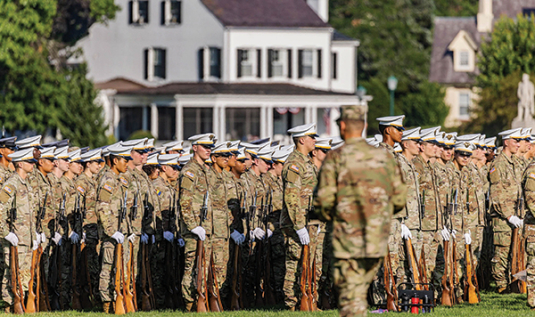
Formerly known as the Commandant’s Unrestricted Fund, the Commandant’s Warfighter Endowment and Fund mobilizes resources to strengthen how cadets train for the realities of modern combat. Through advanced simulations, rigorous field exercises, and immersive real-world scenarios, cadets sharpen their ability to think critically and act decisively.
Investments in cutting-edge tools and realistic training environments build both tactical proficiency and leadership capability, ensuring graduates are prepared to lead soldiers in the most demanding operational settings. The fund also expands access to emerging technologies, Individual Advanced Development programs, major training exercises, and international exchanges. It also supports branch education programs and mentorship opportunities.
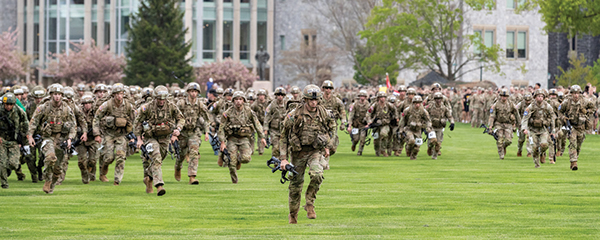
Together, these investments ensure that every graduate leaves West Point not only educated, but fully prepared, grounded in the principles of warfighting, equipped with modern tools, and ready to lead America’s soldiers with confidence and purpose.