Safeguarding America’s Revolutionary History
The remains of one of America’s earliest defenses still stand high above the Hudson River. These Revolutionary War outposts, walls of hand-laid stone, cannon batteries, and redoubts perched on wooded ridges, comprise the original footprint of Fortress West Point. Though George Washington himself called this comprehensive system of fortifications the “key of America,” these primitive defenses are now almost entirely obscured by granite cliffs and deciduous overgrowth.
Despite the 250-year-old shrouded ruins, this “key” remains central to the history and heritage of the United States Military Academy and the United States as a whole. Thanks to the collaboration of the Friends of the American Revolution (FAR), WPAOG, USMA faculty, U.S. Army Garrison West Point, generous donors, and archaeologists, those original fortifications are being preserved, studied, and reimagined for generations of cadets and visitors.
Founded in 2012 by Dr. Betsy Blakeslee HON ’70 and COL (R) Jim Johnson ’69, FAR was established as a 501(c)(3) nonprofit with three core elements. It serves to preserve and protect West Point’s Revolutionary War sites and artifacts from vanishing into the earth. It works to keep their history alive for cadets, faculty and staff, families, historians, and visitors for generations to come. Finally, the effort will enrich the cadet experience through immersive history, staff rides, and capstone projects.
Led by President Kevin Reymond HON ’70, FAR enlists select board members who are also grads ready to assist as the project progresses. Johnson, who holds a doctorate in history from Duke University, taught history at both the Academy and Marist University. John Connors ’70 served as First Captain of the Corps, was captain of the national championship lacrosse team, and was recently inducted into the West Point Sports Hall of Fame. LTC (R) Dave Siry ’94, Academy History and War Studies professor, and the Director of the Center for Oral History, is affectionately known as “The History Guy.”
A Mission to Protect and Educate
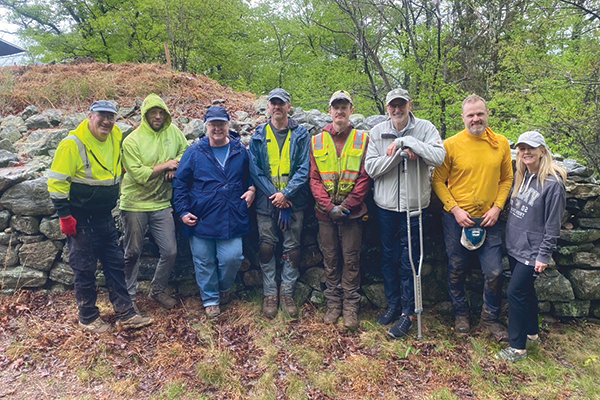
This mission has evolved into a comprehensive preservation plan. At its core is the restoration of the dry-stone elements of these centuries-old walls and batteries, using traditional techniques in partnership with preservation experts from the Dry Stone Conservancy. Beyond the stonework, the project includes installing educational signage and non-firing replica cannons at select sites. Additionally, a virtual reality experience is being developed in coordination with the Academy’s History and War Studies Department, allowing cadets and visitors to see the fortifications as they stood in the 18th century and understand how they functioned during the Revolutionary War.
Remembering the History
When the Continental Army arrived in the Hudson Highlands in 1775, the river represented both lifeline and liability. Control of the Hudson meant dividing New England from the rest of the colonies, and Washington knew the British could crush the rebellion if they seized it.
West Point seemed to be created for a time such as this. Its geography had commanding turns in the river, natural high ground, and sheer cliffs, which made it ideal for impervious defense. Under the direction of brilliant engineers like Polish General Thaddeus Kosciuszko and French officers Louis de la Radière and Major Villefranche, the Continental Army built a system of 16 redoubts, eight artillery batteries, and the legendary Great Chain, a 35-ton iron barrier that stretched across the river to stop British ships.
Washington’s instincts proved correct. The British never breached Fortress West Point, though Benedict Arnold’s treachery nearly delivered it to them. As Washington later reflected, West Point was indeed the “key of America.”
Safeguarding Washington’s Vision
After two and a half centuries, the work of preserving this “key” has taken on urgency. Many fortifications are crumbling from erosion, encroaching trees, and time itself.
FAR has already accomplished major projects:
- Kosciuszko’s Garden;
- Fort Meigs, preserved in 2019;
- Fort Clinton, Water Battery, Lanthorn Battery, and Chain Battery, completed in 2024; and
- Redoubt 4 Phase I restoration, finished spring 2025, with Redoubt 2 currently underway.
During the Chain Battery restoration, masons uncovered five additional feet of original wall and even a cannonball still fused, which was later destroyed for safety. These discoveries further highlight the historical and archaeological value of the sites.
Bringing Innovation to Preservation
For cadets, these preserved fortifications are more than history, they are living classrooms and laboratories for leadership and scholarship. Cadets from departments across the Academy integrate the sites into capstone projects, engineering designs, and historical research.
The Department of History and War Studies’ Digital History Center has developed dronebased 3D modeling, allowing cadets to manipulate virtual reconstructions of the redoubts. The drone captures tens of thousands of images, which are processed into a 3D model that can be rotated and viewed from every angle. This technology lays the foundation for a virtual reality history experience for researchers and visitors.
The Department of Civil and Environmental Engineering contributes to the project as well. Cadets create digitally designed presentations, structurally sound viewing platforms, and anchoring systems for replica cannon, gaining hands-on experience in both preservation and applied engineering.
Cadets also engage with the fortifications through on-site experiences and classroom instruction. While many have participated in staff rides at distant battlefields, here they can explore Revolutionary War sites right on campus. This immersive experience helps cadets understand how geography, fortifications, and strategy shaped history.
Beyond Classroom Use
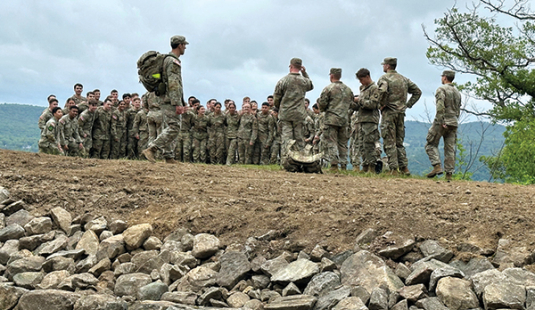
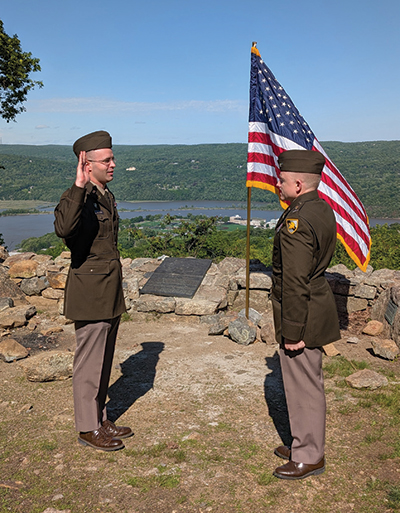
“These fortifications are an integral part of the 47-month cadet experience,” says Siry. “They’re not just studied—they’re used, celebrated, and remembered.” They are living, physical classrooms that serve purposes beyond academics. Officers, cadets, families, and visitors engage with the sites for milestone events, from promotions and bar-pinning ceremonies to Sandhurst victory celebrations. In more recent years, they have become part of annual Recognition Day traditions for plebes.
Families and community groups also find meaning in these spaces. Organizations like Thayer Leadership incorporate the fortifications into leadership programs and tours.
They even integrate the arts. Siry recalls one plebe who braved a thunderstorm to hike to Fort Putnam for the opportunity to view The Last of the Mohicans in a historic setting.
Special events further highlight the living nature of these sites. This fall, a couples’ date night will start at Trophy Point and wind its way down to Flirtation Walk, stopping along the way to hear stories of the American Revolution on that key piece of terrain. Earlier this year, the Academy conducted a 21-gun salute honoring President Jimmy Carter from Redoubt 4, reinforcing that these fortifications remain integral to the infrastructure and daily life of West Point.
Building Momentum
Preservation on this scale requires Margin of Excellence funding to complete the restoration of all West Point and Constitution Island sites. Alumni classes have been instrumental. The Class of 1970 launched the effort, followed by the Class of 1969 and the Class of 2009. These commitments are fueling ongoing work and setting the stage for larger campaigns as the 250th anniversary of the American Revolution approaches in 2026.
“This is a brick-and-mortar giving opportunity,” says Connors. “It’s a chance for classes, families, and foundations to leave a tangible legacy at West Point that will last another 250 years.”
The roadmap to completion is ambitious. The goal is to finish West Point fortifications by 2029 and the Constitution Island sites by 2033. For Blakeslee, Reymond, Johnson, Connors, Siry, and the many volunteers and donors behind the project, it’s about more than restoration, it’s about stewardship. By preserving these fortifications, we honor that legacy and ensure that future generations of cadets, historians, and citizens understand the price of our independence and the role West Point played in securing it.
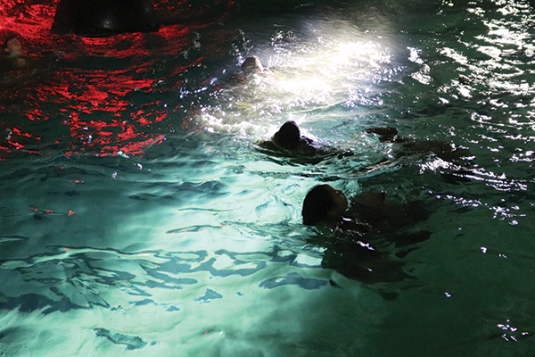
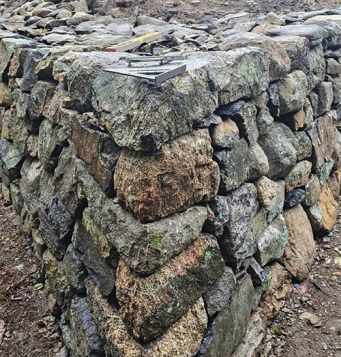
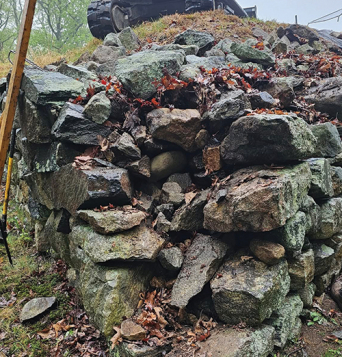
Photo 1: Dry Stone Conservancy partners Neil Rippingale, Ned Thilo, Jane Wooley, Zach Goebelt, Kurt Freisner, Kevin Reymond (FAR), Seth Thomas, and Leigh Major (WPAOG). Photos 2 & 3: Redoubt 4 shown before and after restoration. Photo credit: Seth Thomas. Photo 4: A company of plebes enjoying Recognition Day ceremonies. Photo 5: An officer taking the oath during a promotion ceremony from Redoubt 4.