Some things do stay the same: the Academy has long upheld a tradition of rigorous physical and mental preparation for cadets. The Department of Physical Education (DPE) fulfills this objective by developing leaders with a warrior ethos, movement lethality, and performance expertise through rigorous, iterative, and developmental Physical Education and Kinesiology curricula.
To produce physically fit and mentally tough leaders, the department administers standards-based, demanding physical fitness assessments such as the Indoor Obstacle Course Test, Army Combat Fitness Test, Marne Confidence Course, and the Water Confidence Course. These assessments require commitment to holistic health and fitness and optimal performance on and off the battlefield. Among the most formidable challenges cadets face is the Combat Water Survival Swim Laboratory, a state-of-the-art facility designed to simulate operational conditions.
A Facility Like No Other
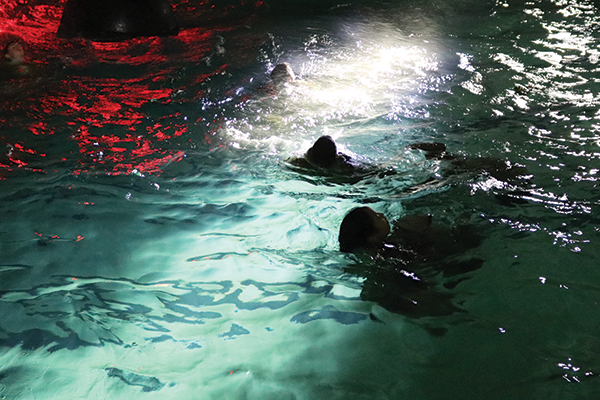
Originally constructed in 2005 as a standard swimming pool, the Combat Water Survival Swim Lab was rapidly transformed into an advanced classroom environment. The facility features wave simulation, artificial fog, battlefield sound effects, and strobe lighting to replicate the chaos of combat situations. Cadets must prove their water survival skills by completing the grueling five-minute ACU Survival Swim and the Survival Gate #4 challenge—tasks that require them to swim in complete combat uniform with equipment while navigating realistic obstacles.
The significance of this facility cannot be overstated. Every West Point cadet, regardless of their background, must pass through its waters. It is a test of endurance, adaptability, and courage—qualities essential for future military leaders. Here, cadets learn to face adversity with confidence and resilience.
“The Combat Water Survival Swim Lab [wave pool] forges the warrior ethos,” said program director COL Aaron G. Parks ’03. “In the aquatics environment, as in battle, there is no room for doubt or hesitation—relentless, realistic training and unwavering determination lead to victory.”
Simulating the Fog of War
At West Point, mental and physical toughness is tested daily—but few challenges rival the intensity of Survival Gate #4, the culminating event in the Department of Physical Education’s rigorous Survival Swimming course. This high-stakes assessment pushes cadets to demonstrate their grit, resourcefulness, and readiness under combat-like water conditions.
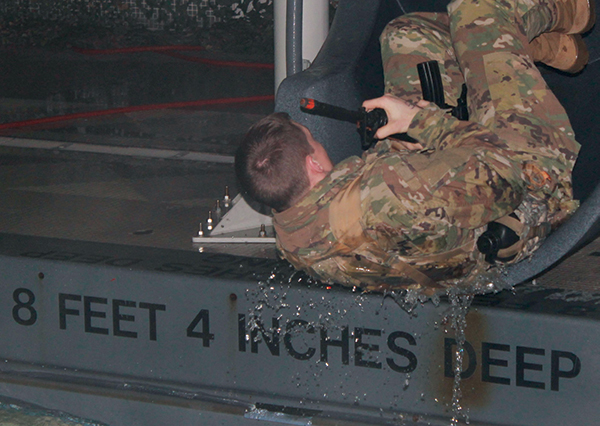
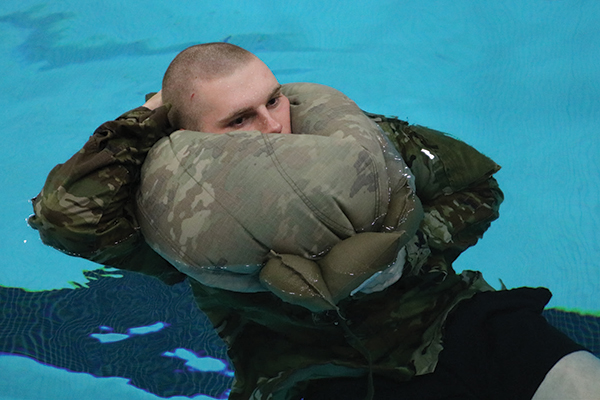
Survival Gate #4 is far more than a swim test. It recreates the chaos of a battlefield water hazard using a combination of disorienting stimuli: 24-inch waves, fog, simulated rain, strobe lights, and booming battlefield sound effects. Cadets are required to enter the water using a head-first rear slide entry and navigate the turbulent conditions while wearing full military gear—including an Army Combat Uniform, bloused boots, MOLLE vest, belt, and a replica M4 rifle.
These physical and environmental challenges are designed to simulate real-world conditions a soldier might face during combat water operations. The goal: ensure that each cadet is not only a capable swimmer, but also someone who can stay calm and make sound decisions in high-stress, low-visibility scenarios.
One Shot to Pass
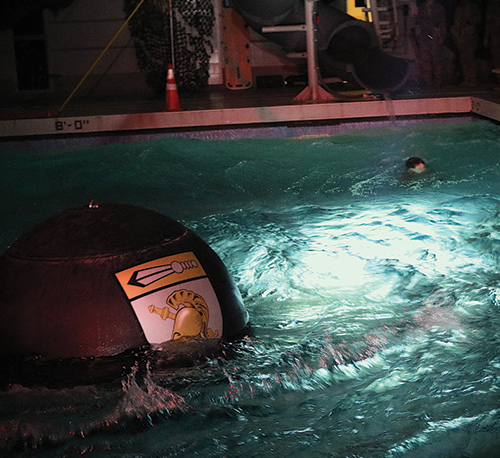
Survival Gate #4 is a one-attempt test. Cadets must successfully complete the assessment to pass the course, making preparation and mental focus paramount. Throughout the semester, cadets build toward this final gate with focused swim training that includes breath control, stroke refinement, and techniques for navigating water while fully equipped.
For those lacking strong swimming abilities, the course offers structured opportunities for improvement, ensuring that all cadets—regardless of experience—can meet the standard.
Survival Gate #4 is one of the defining moments of the cadet experience. It demands composure under pressure, mastery of essential skills, and the kind of tenacity that exemplifies the Army officer corps. Those who complete it emerge with not just a stronger stroke, but a deeper sense of confidence in their ability to face the unknown.
Supporting the Long-Term Mission
Now, there is an opportunity to leave a legacy by naming this critical facility, ensuring it continues to contribute to cadet readiness for generations to come.
Endowing this facility will secure the perpetual funding needed for maintenance and upgrades, ensuring the lab remains the cutting edge of training technology. Additionally, it will allow faculty and staff to implement other essential programs within the Department of Physical Education, further enhancing cadet physical development programs.
By naming the Combat Water Survival Swim Lab, benefactors contribute directly to the continued excellence of cadet training and ensure that West Point’s high standards never waver.
The tradition of supporting DPE facilities through class gifts is well established at West Point. Past classes have made substantial contributions, resulting in the naming of several key training areas:
- The Class of 1962 Rooms
- The Class of 1972 Boxing Room
- The Class of 1979 Climbing Wall
- The Class of 1994 Courage Corridor
Preparing the Next Generation
Year after year, cadets reminisce and compare stories about their various survival swim experiences. Cadet Mike Teplansky ’27 shared, “The combat lab was a total eye opener and made me realize why survival swim has the word ‘survival.’ Of my experiences at West Point, the combat pool truly was one of the most memorable. Being put in that level of stress and pressure really makes you feel how vulnerable humans really are to the whims of Mother Nature and truly made me rely on my training to survive. In short, it was absolutely epic.”
Photo 1: The test is performed in low light conditions. Photo 2: To pass, cadets must perform a head-first, rear slide entry with full tactical load. Photo 3: A cadet uses OCP trousers as a flotation device. Photo 4: The pool is equipped with a sophisticated, high-maintenance wave machine.