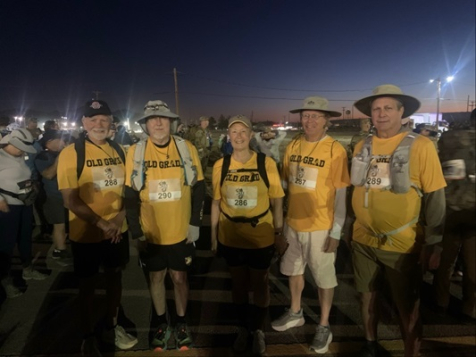
Cadets at the U.S. Military Academy stepped off on the evening of February 27 for the Norwegian Foot March, an 18.6-mile endurance event that supports West Point’s top priority: developing leaders of character by testing discipline, decision-making and resilience under stress.
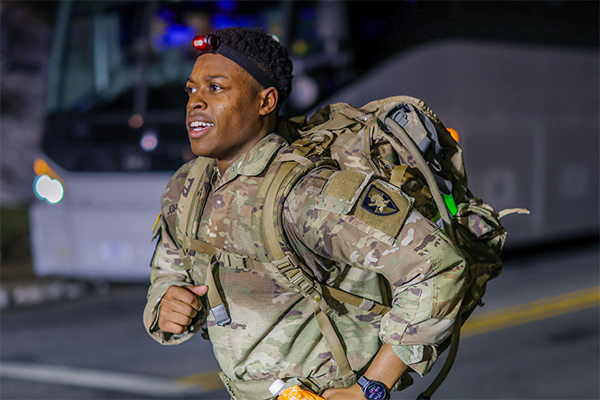
The march began at 6:00pm and continued into the early morning hours of February 28, with the last marcher completing the course at 1:46am. Headlamps, glow sticks, and reflective belts traced the route through West Point’s hills as participants moved under load in cold, dark conditions.
A total of 2,074 participants took part in the event. CDT Aidan Twomey ’29 (Black & Gold/B2) recorded the fastest time, finishing in 2 hours, 25 minutes.
The top three male finishers were Twomey, CDT Cooper McNee ’29 (E3) in 2:30, and CDT Ciaran Bowler ’26 (G2) in 2:36.
The top three female finishers were CDT Sarah Sicat ’29 (B3) in 2:49, CDT Emma Liesen ’27 (A1) in 2:52, and CDT Faith Riccobene ’26 (F1) in 2:58.
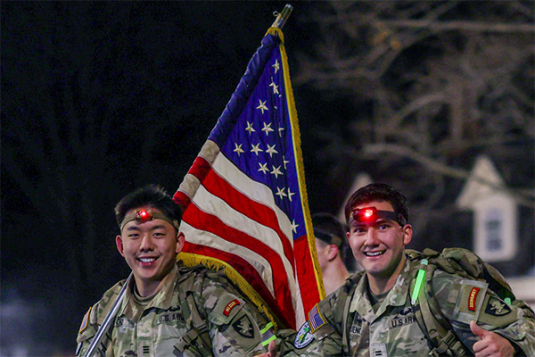
Known as Marsjmerket, the Norwegian Foot March began in 1915 as a Norwegian Army test designed to ensure soldiers could move long distances under load and remain effective afterward. The event’s standardized requirements have helped it spread worldwide, including across U.S. military units and schools that use it as a benchmark of physical and mental stamina.
CSM Anthony D. Powers Jr., Command Sergeant Major of the U.S. Corps of Cadets, said the hardest stretch comes when fatigue sets in and cadets must decide whether to keep moving forward.
“When you hit about mile 10, that’s when you start hitting that wall,” Powers said. “What I hope is in their ability to overcome adversity, to push beyond their physical limits, and the discipline it takes to just keep going.”
Cadets managed pace, hydration, nutrition, and safety while moving under load through darkness and uneven terrain. West Point leaders said those repeated decisions under fatigue reflect how the academy develops leaders of character — through standards, accountability, and deliberate practice in difficult conditions.
Leaders also said the event aligned with the Army’s priorities of warfighting, delivering ready combat formations, continuous transformation, and strengthening the profession. Powers said the march demonstrates core warfighting fundamentals such as moving under load.
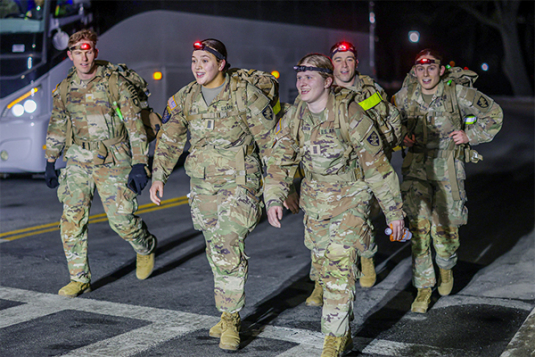
“Soldiers have been marching since the beginning of armies,” he said. “Marching is the base of what soldiers do to be able to get to combat and the endurance it takes to move their combat load into the fight.”
The march also reinforced readiness at the team level as cadets adjusted pace, checked on one another, and made small decisions that affected group success, habits leaders said carry into units and formations. Leaders described that approach as part of continuous transformation by applying a century-old, allied standard in a modern training environment with deliberate preparation and risk management.
Powers said the profession of arms is strengthened when leaders hold themselves to standards even when no one is watching.
“That moment when you’re out on the trail, when nobody’s pushing you, it’s all about self-accountability,” he said. “They’re not doing it for themselves. They’re doing it for their people.”
By the end of the night, finishers crossed the line quietly, collected water, and adjusted their gear before returning to their weekend routine — closing out an event leaders described as less about spectacle than steady leader development.
The excerpt and images were taken from https://www.westpoint.edu. Story by SGT 1st Class James Avery. Photos by SGT 1st Class Alan Brutus/USMA Protocol-PAO.