
By Desrae Gibby ’91, WPAOG Staff
May 15–17, 2026 marked a historic milestone for Army Crew as West Point fielded a complete team for the first time at the American Collegiate Rowing Association (ACRA) club national championship, the largest collegiate regatta in the country by entries and teams. In true warrior-scholar fashion, the Black Knights proved they are as sharp as the Athenians and as relentless as the Spartans. Army Crew dramatically elevated its national standing with the women’s team ranked fourth in the nation (two rowers selected to All-American teams), and the entire program ninth. Also impressive, Army earned the seventh-most First Team All-Academic awards, proving these athletes dominate both the water and the classroom.
The Army Crew team leadership Director of Rowing Kate Brownson, Officer-in-Charge MAJ Kate Rutherford ’14, Coach Dave Kammen ’89 and Coach Isabella Sanders accomplished an incredible logistics and planning feat similar to executing a field exercise, with more than 50 cadets and millions of dollars’ worth of equipment. Some of the team flew and some drove to Oak Ridge, Tennessee. Cadets learned convoy procedures and planned the complicated “troop movement,” with a detailed OPORD. The professional payoff was undeniable.
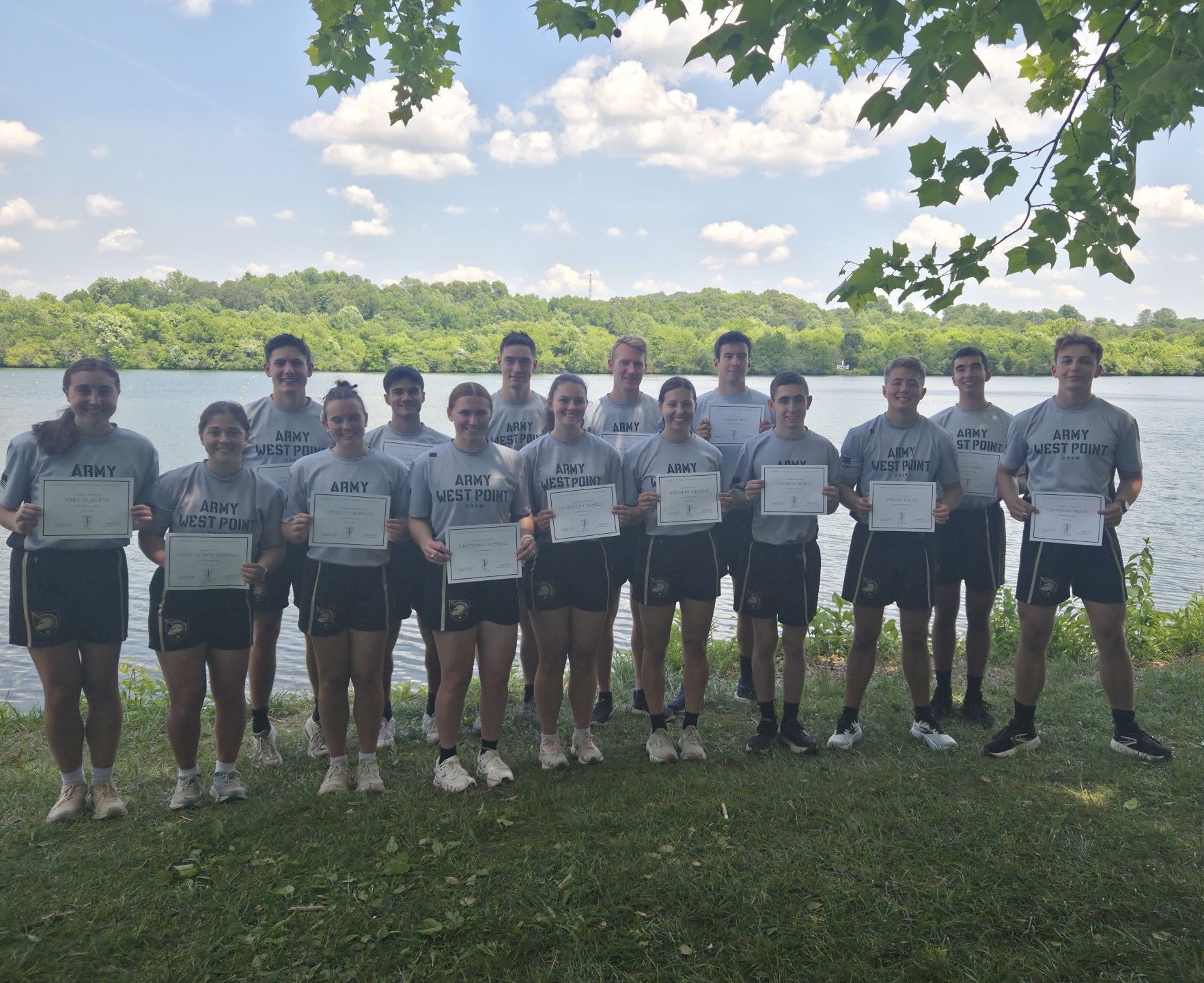
Eighty-four clubs and 397 entries from all over the country rowed hard, and it was a nailbiter every time Army raced. Army made it to the prestigious Grand Finals in three events—Women’s Varsity Eight (WV8+), placing fifth, Second Varsity Eight (W2V8+), placing fourth, and Women’s Novice Eight (WN8+) placing fourth. The Army women’s team finished 4th overall for team points behind Purdue, UC Santa Barbara and Bowdoin, three renowned ACRA teams, and ahead of Vanderbilt who was second last year.
The WV8+ rowed in the LTC Jaimie Leonard ’97, honoring the fallen rower known for urging teammates to “embrace the suck.” In 90-degree heat, they lived up to her legacy. Coxswain and future Commodore Amelia Cropper ’27, Team Captain and Stroke Kennedy Hecker ’26, Gretchen Russell ’26, Hailey Bovino ’27, Jordan Wilson ’28, Lily Jordan ’28, Cece Crowley ’28, Madeline Zais ’28, and Emma Baron ’28 all fought hard in the premier WV8+ Grand Final. Hailey Bovino and Jordan Wilson were selected for the Second and Third All-American Teams, respectively.
The Army men’s team was equally aggressive and emptied their tanks on the water. The Men’s V4+ rowing in the Sua Sponte had a very strong showing in a super competitive category with the most entries of the race, 33 crews and five heats. They placed third in their final, finishing 8th overall. Their lineup was Coxswain Ian Smith ’28, Stroke and Team Captain Calvin Shepler ’26, Ian Howell ’26, Joah Miller ’26 and Ronan Engel ’26.
The Men’s Novice 4+ placed second in a hard-fought photo finish for the E final in the event with the second most entries—32. They dropped 14 seconds from their time the previous day. The M2V8+ dropped 13 seconds from their row the day before.
In the prestigious MV8+, the men’s team finished second in the D Final with 29 crews competing. Purdue won the Grand Finals with an incredibly fast 5:58, and West Point was only 26 seconds behind (showing how competitive this event was). In the semifinal, Boston College had beaten Army by three seconds, but in the final Army fought viciously in the sweltering heat, dropping 14 seconds from their time the day before and beat Boston College by a split second.
Army Crew also produced 10 First Team All-Academic honorees and six Second Team honorees, a testament to their discipline and academic rigor.
Joah Miller ’26 received an All-Region award based on his 2K score, performance, career racing results, individual performances, and coach recommendations.
Special shout out to Team Commodore Ian Howell ’26 who showed remarkable leadership this pivotal year.
Donor support provides the critical difference, allowing the Army Crew team to compete at a higher level. The Margin of Excellence helps with travel to national regattas, upgraded equipment, and training opportunities that would not be possible through standard government funding alone.