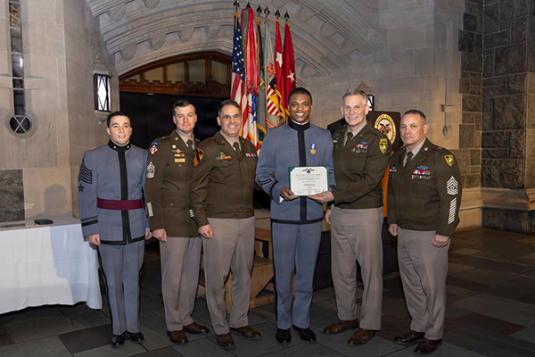
The West Point Association of Graduates (WPAOG) has named the 2026 recipients of the Distinguished Graduate Award. This annual award has been bestowed upon those West Point graduates whose character, distinguished service, and stature draw wholesome comparison to the qualities for which West Point strives, in keeping with its motto: “Duty, Honor, Country.” Chosen by a committee of their peers, these recipients represent the highest standards of leadership, selfless service, and lifelong commitment to West Point and the nation. Thank you to the committee members for their time, debate, and discussion, and their final selections. Thanks also to all the graduates who submitted the exceptional 35 nominations this year, a record year for our Association, and to the DGA Committee for its thoughtful and dedicated attention to this important tradition. In addition to this year’s awardees, we will proudly recognize Kathy Widmer ’83, who was unable to participate in last year’s ceremony. The awards will be presented in a ceremony at West Point on May 19, 2026.
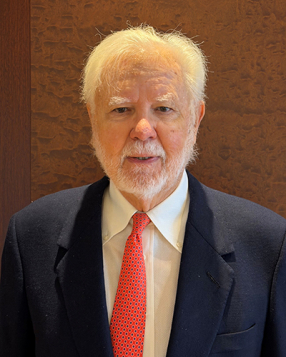
Mr. Michael C. Mewhinney ’66
Mike Mewhinney’s post-graduation life has been anything but ordinary, encompassing nearly six decades of Duty, Honor, Country through distinguished military service, extraordinary business achievement, and transformative philanthropic leadership in support of the United States Military Academy and beyond. Commissioned into the Signal Corps, Mewhinney completed Ranger School and served with distinction in Germany and Vietnam, commanding a company in the 459th Signal Battalion in combat and earning the Bronze Star and Army Commendation Medal. After leaving active duty, he earned an MBA from Harvard Business School and embarked on a highly successful career in finance and later co-founded Barrow, Hanley, Mewhinney, and Strauss (BHMS), which grew into one of the nation’s premier investment advisory firms, managing more than $60 billion in assets for blue-chip corporate, educational, and foundation clients. In 1986, a visit to West Point and a meeting in Quarters 100 with LTG Dave Palmer ’56, the 53rd Superintendent, sparked a defining epiphany that redirected Mewhinney’s focus to funding various cadet and Academy activities. Since then he has contributed or committed more than $50 million to USMA. Furthermore, in 1999, Mewhinney became a member of the AOG Board of Trustees and helped modernize the Academy’s Endowment Fund while serving as chair of AOG’s Investment Committee, growing the fund more than 12-fold in 25 years. Beyond West Point, Mewhinney’s generosity has profoundly impacted education, healthcare, cultural institutions, and underserved communities in his local Dallas, Texas community and nationwide, including the Dallas County Community College District, North Texas Food Bank, Children’s Medical Center Dallas, the Dallas Museum of Art, First Liberty, the Medal of Honor Foundation, Tunnels to Towers, and Darby’s Rangers Foundation, “While I make it a practice not to provide recommendation letters, I’m pleased to break my own policy…[and] proudly endorse Michael C. Mewhinney for the Distinguished Graduate Award,” says former President George W. Bush.
COL (R) B. Hudson Berrey ’72
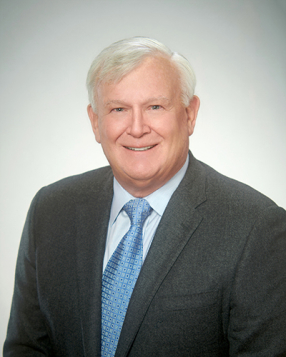
Repeatedly named one of the “Best Doctors in America” and the recipient of numerous teaching excellence awards, COL (R) B. Hudson Berrey has distinguished himself through combat service, academic excellence, humanitarian leadership, and unwavering commitment to patients and the profession of medicine. After graduating from West Point, Berrey earned his medical degree from the University of Texas Medical Branch with a residency in orthopedic surgery. He rapidly rose in responsibility, serving as chief of orthopedics at Gorgas Army Hospital, Panama, and being selected for the highly competitive Orthopedic Oncology Fellowship at Harvard Medical School. From 1985 to 1993, he served concurrently as chief of orthopedic oncology and chief of orthopedic surgery at Walter Reed Army Medical Center. He was also an associate professor at the Uniformed Services University of the Health Sciences, establishing himself as the Department of Defense’s foremost orthopedic oncologist. During the Gulf War, he deployed with the 85th Combat Support Hospital as deputy commander for clinical services, where his leadership during a SCUD missile attack saved lives and earned unit-level national recognition. He later served as the orthopedic consultant to the Army Surgeon General, who later wrote: “Hud has always impressed me most by how he exemplifies the shared values of military and medicine…integrity, selfless service, professionalism, respect, and leadership.” Following his Army retirement, Berrey served as professor and chair of orthopedic surgery at the University of Florida (UF) College of Medicine, later becoming professor and chief of orthopedics and musculoskeletal oncology at UF Shands Hospital, where he expanded trauma care, residency training, and global medical missions. In 2008, he returned to active duty in Iraq; in 2010, he led a medical team to Haiti following a devastating earthquake; and, in 2023, he began training surgeons in Ukraine, a practice he continues to this day.
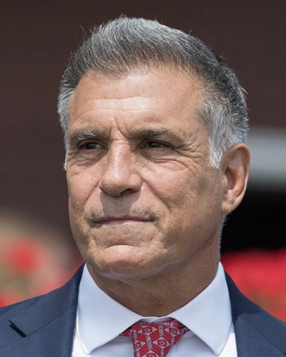
Mr. Vincent Viola ’77
Few graduates have shaped the Academy—and the Army—quietly yet so profoundly as Vincent Viola. His vision and philanthropy have strengthened the Academy’s intellectual foundation and ensured its excellence as both a military and academic institution. He is the driving force behind numerous Margin of Excellence initiatives, which have transformed cadet education and extended West Point’s influence across the Army and the nation. For example, in the wake of the September 11 attacks, Viola recognized the emerging threat of terrorism and spearheaded the funding for the establishment of the Combating Terrorism Center, now a respected authority. Similarly, his early backing of the Modern War Institute has reshaped professional military discourse, with its publications and podcasts widely consumed by Army leaders worldwide. Beyond West Point, Viola has rendered invaluable service to the Army, with several Chiefs of Staff seeking his counsel on a range of issues. Additionally, he established the General Wayne A. Downing Scholarship Program, which quickly became the most successful of the Army’s many graduate school programs and has produced several exceptional operational leaders. Viola’s civilian leadership is distinguished. In 2008, after serving as chairman of the New York Mercantile Exchange, he cofounded Virtu Financial, now a global leader in financial markets. He has also achieved championship success as the co-owner of Always Dreaming, the 2017 winner of the Kentucky Derby, and as the owner of the back-to-back Stanley Cup-champion Florida Panthers (2024-25). Across business, sport, and philanthropy, his leadership emphasizes teamwork, integrity, and impact. Perhaps most telling is Viola’s humility. Despite being West Point’s leading donor, he eschews recognition, choosing instead to inspire others through quiet generosity. Says Gary Bettman, Commissioner of the National Hockey League, “In character, achievement, and lifelong devotion to West Point, Vincent Viola stands as a sterling example of the national significance the Distinguished Graduate Award is meant to illuminate.”
GEN (R) Vincent K. Brooks ’80
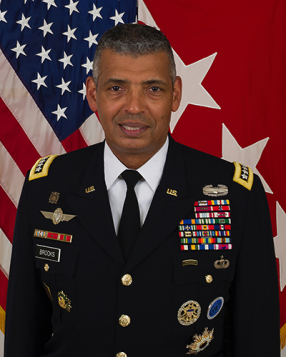
“The words ‘Duty, Honor, Country’ are ingrained in General Brooks’ character,” says LTG (R) Robert Caslen ’75, 59th USMA Superintendent. Entering West Point in America’s 200th year of independence, with the historic Class of 1980, Brooks quickly became an exemplar in his class. After earning the Ranger Tab from the U.S. Army Ranger School while a cadet, Brooks was selected to serve as the Cadet First Captain, adding to the historic achievements of the Class of 1980 and leading the Corps of Cadets in the first year that women were members of every class. Commissioned as a second lieutenant of Infantry, Brooks served with distinction in some of the Army’s most storied units while rising in command roles from platoon leader to four-star multinational and joint command over his nearly 39 years on active duty. His initiatives in developing strategies for the deployment of forces around the world continue to the present day as Operation Spartan Shield in the Middle East and Operation Pathways in the Indo-Pacific. He is known for developing trust with Allies and partners and building highly effective, cohesive combat-tested units while communicating easily with enlisted troops, international media or presidents. Since Brooks’ 2019 retirement from active duty he continues to serve in new ways: as a board director in the public sector as well as in non-profit veteran service organizations; as a consultant and thought leader at Harvard University, at the University of Texas at Austin, and at West Point as the Class of 1951 Chair for the Study of Leadership in the Department of Behavioral Sciences and Leadership; as a consultant; and as an advisor to the Central Intelligence Agency director and to the secretary of defense. He continues to give back to those still serving and striving for excellence.
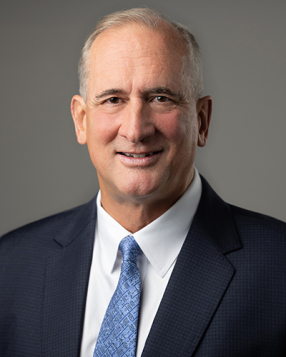
GEN (R) Bob Brown ’81
“General Brown has lived the West Point values of Duty, Honor, Country in every chapter of his life to the highest level,” says Coach Mike Krzyzwski ’69, who recruited Brown for the Army Men’s Basketball Team in the late 1970s. Brown’s experience on that team, including serving as its co-captain, shaped his approach to leadership, an approach committed to trust, empowerment, and building strong teams. Commissioned as an Infantry officer in 1981, Brown served more than 38 years on active duty. A scholar-leader, he earned a Master of Education from the University of Virginia and a Master of Science in national security and strategic studies from the National War College, graduating as a distinguished graduate. As commander of the 1st Brigade, 25th Infantry Division, he helped operationalize the Stryker Brigade Combat Team and led combat operations in Mosul and northern Iraq during Iraq’s first post-Saddam elections. As commanding general of the Maneuver Center of Excellence, he unified the Infantry and Armor schools and refocused the Army on the squad and soldier. At the strategic level, Brown led the Army’s “Rebalance to the Pacific” as commanding general of I Corps. As the Combined Arms Center, Fort Leavenworth commanding general, he established Army University (unifying over 70 Army schools under a single academic framework) and authored Field Manual 6-22 (Leader Development). As commanding general of the U.S. Army Pacific, he led the implementation of Multi-Domain Operations in the Pacific and pioneered the Multi-Domain Task Force concept. Since retiring in 2019, Brown has served as President and CEO of the Association of the United States Army, increasing its membership nearly ten-fold. He credits any success, to the incredible support of his wife of 44 years, Dr. Patti Brown. He remains an active mentor, advocate, and inspirational leader in support of cadets, soldiers, and the Profession of Arms.
GEN (R) Darryl A. Williams ’83
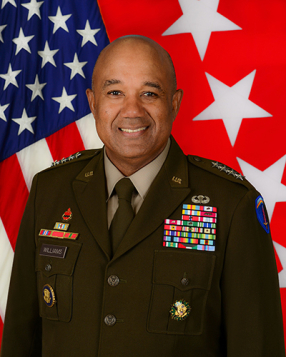
In 41 years of exemplary service as a soldier, leader, and steward of the Army profession, Darryl Williams has held assignments across the globe and across West Point. After commissioning as a Field Artillery officer, he served in Germany in an 8-inch nuclear capable artillery unit—1st Battalion, 76th Field Artillery. He later commanded B Battery, 3rd Battalion, 27th Field Artillery and deployed in support of Operation Desert Shield/Desert Storm. After serving as a USCC tactical officer, he attended the Army Command and General Staff College and SAMS and was later selected to serve as Army aide to the president of the United States. After commanding the 3rd Battalion, 16th Field Artillery, Williams returned to West Point as a regimental tactical officer, where he mentored cadets in the principles of Duty, Honor, Country. After attending the U.S. Naval War College, he commanded 1st Armored DIVARTY and later deployed to Operation Iraqi Freedom. He then commanded the Army’s Warrior Transition Command, overseeing the care and rehabilitation of wounded, ill, and injured soldiers. Next, he served as ADC(S) of the 2nd Infantry Division in South Korea. Williams then took command of U.S. Army Africa and led Operation United Assistance in Liberia, directing the U.S. response to the Ebola outbreak, significantly containing the epidemic. As the 60th Superintendent, Williams guided West Point through the unprecedented challenges of the COVID-19 pandemic while preserving the institution’s mission and traditions. His Army career culminated as commander, U.S. Army Europe/Africa, and commander, NATO Allied Land Command, where he strengthened deterrence and reinforced alliance readiness during a period of heightened global instability. GEN (R) Jim McConville ’81, 40th Chief of Staff of the Army, says, “General Williams’ contributions to the Academy, the Army, and the nation make him not only a highly deserving candidate but a perfect example of the ideals that West Point instills in its graduates.”