
By Jane Anderson, WPAOG Staff
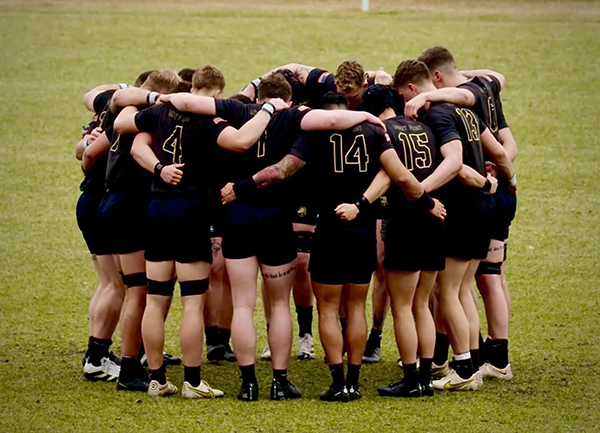
Within the realm of Army West Point Men’s Rugby lies a startling history: The typical U.S. Military Academy cadet has a 1 percent chance of donning general stars, but that number triples to 3 percent for Army rugby players. Intrigued, Army ruggers-turned-filmmakers Sean Mullin ’97 and Brian Anthony ’01 set out to find the reason for that anomaly. The result is Brothers on Three, a documentary created and produced by grads that followed the team for a full year after its historic 2022 National Championship win. On November 14, former and current ruggers gathered at Eisenhower Hall to watch the film and kick off an event-filled rugby weekend. Brothers on Three premiered nationwide in Regal Cinemas on November 7.
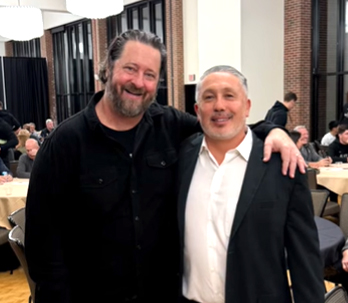
“Leadership is formed and challenged on the rugby pitch,” Mullin explained. “Rugby is a sport that’s intense, with a lot of chaos happening around you, as it is on the battlefield.”
His fellow filmmaker agreed. “I served as a Ranger and with Special Forces, but my hard work began on the Army rugby team,” says Anthony, who was a scrum-half and captain on the Army pitch. “What it taught me was not to quit, and that ability not to quit took me pretty far.” Anthony commissioned Infantry upon graduation and served in the Army until 2010. He is a television writer-producer by trade and served as both writer and producer on the documentary.
An Artillery officer after graduation, Mullin served as an Officer in Charge at Ground Zero after 9/11. He later earned a Master of Fine Arts degree in film from Columbia University. But before all of that, Mullin was an Army West Point rugger for all eight semesters at USMA, and that’s where the idea for the film was born, he said. “I knew I was part of something special at the time, but I had no idea just how extraordinary this program’s impact would prove to be,” Mullin explained. “I thought I was going to be making a rugby film. Instead, it’s about a group of resilient young men displaying positive masculinity, which is unusual at this time.
“Men are often forced to pick a lane—either be tough or be kind—and yet here’s a group who embraces both.”
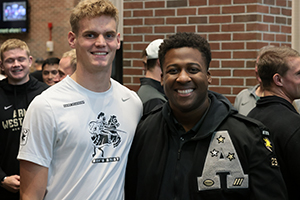
The team’s core values of trust, commitment, and love form the film’s foundation. In it, Team Captain Larry Williams ’23 (right) encapsulated Army West Point character development when he said, “I realized that being a good leader isn’t about how much you win—it’s how you handle loss.” Williams and other teammates who appeared in the film were part of a 500-attendee dinner and jersey presentation at Ike Hall’s ballroom prior to screening the film in the Ike Hall theater, and a Q&A afterward.
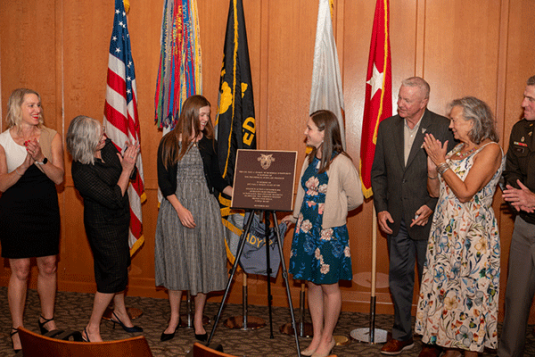
At the Army-Navy rugby match the following day (final: Army 16, Navy 21), Army West Point Athletics dedicated a bronze bust of former Coach Michael Mahan ’70 at Anderson Rugby Complex. Mahan coached Army Rugby for 27 years, including 10 Final Four appearances, and later helped launch the women’s rugby program.
Dean Dorman ’86 played Army rugby for three years under Mahan’s guidance and is one of the executive producers of Brothers on Three. In addition to Mullin, Anthony, and Dorman, more than a dozen other USMA graduates contributed to the film in production and other roles. The film’s inspiration extends beyond Warrior Field, Dorman said. “For Cadet candidates, it will encourage them to attend West Point,” said Dorman, co-founder and co-chairman of the Army Rugby Alumni Council. “And for other teams, other organizations, it provides insights that come from being part of a special environment, and they can deploy those insights to improve their own organizations, families, or friendships.”
Army Rugby Head Coach Matt Sherman said that Brothers on Three conveys being a cadet in this program as a meaningful and formative part of the 47-month journey at West Point—one that shapes individuals who will positively impact the force and our country.
“The film elevates Army Rugby by showing that our program is fundamentally about developing leaders of character who are prepared to fight and win,” the coach said.
When Army rugby players step onto Warrior Field, they also do so with respect for fallen former players—because the ashes of some of those fallen soldiers have been scattered there, a fact that’s poignantly depicted in the documentary.
Among the former ruggers who have passed is Captain Ian Patrick Weikel ’97, who died in 2006 while deployed in Baghdad. His surviving spouse, Wendy Green ’98, and son, Cadet Jonathan Weikel ’27, attended the screening.
And when the Army team faced their Navy rivals the day after the screening, they played in honor of Steve Dwyer Jr. ’09, an Army rugger, former Army Ranger, and “Night Stalker” helicopter pilot, who died in a helicopter crash over the Mediterranean on November 10, 2023.
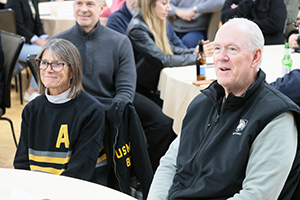
Dwyer’s parents, Steve Dwyer Sr. ’80 and Gail Dwyer ’81, attended the screening Friday night. The senior Dwyer—a former Army rugger himself—spoke at the jersey presentation at Eisenhower Hall.
“My son loved this team more than anything,” Dwyer told the 500 people in the ballroom. “There’s a term we used when I played rugby here: ‘With You.’ It’s how you know you have your brothers with you. And you don’t really know who the hero is, because they’re all heroes on this team.”
Several in attendance wore T-shirts depicting the logo “Dwyerfire” — the nonprofit founded by the Dwyers in honor of their son. Dwyerfire GoldStar Foundation supports and mentors Gold Star children through athletics and fitness.
“My son would have loved it,” the elder Dwyer said of Brothers on Three. “His 9-year-old son, Landon, saw it in the theater and at the end, he stood up and announced, ‘That was the best movie ever!’”
The Dwyers agreed that Brothers on Three perfectly captured the ethos of the team and the sport. “After seeing that movie, how could you not want to be a part of the Army Rugby team?” Gail said.
In an interview, Mullin noted that less than 1,000 men have worn an Army Rugby jersey. Contrast that with the percentage of rugby players who have gone on to become general officers, and it’s easy to see that Army ruggers are a rarefied group. Coach Sherman said it best when, during the jersey presentation, he told his team: “This jersey represents shared sacrifice and hardship, and the impact that you’ll have on our Army and on our country.”
Images provided by Army Athletics.