

By Keith J. Hamel, WPAOG staff
The West Point Association of Graduates will be publishing the 2025 Register of Graduates & Former Cadets in the spring. This 77th edition of Brigadier General George W. Cullum’s (Retired), Class of 1833, “herculean task” (as he called his Register in its 1891 third edition) has several features readers should enjoy. One such feature is the “Past USMA & WPAOG Leadership” list. Looking at this list, some interesting West Point trivia jumps out. For example, the list shows that Major General Richard Delafield (Retired), Class of 1818, served as Superintendent on three separate occasions (7th, 11th, and 13th); that Major General Robert C. Davis (Retired), Class of 1898, served as the AOG Chairman for only two months in 1944 (dying in office); and that two former Commandants were later appointed as Superintendents (Lieutenant General Robert Caslen ’75 [Retired] and Lieutenant General Steve Gilland ’90). Yet, perhaps the most fascinating tidbit to learn from studying this list is that a first lieutenant of the U.S. Army was once appointed Superintendent of the U.S. Military Academy. That officer was First Lieutenant Albert Leopold Mills, Class of 1879.
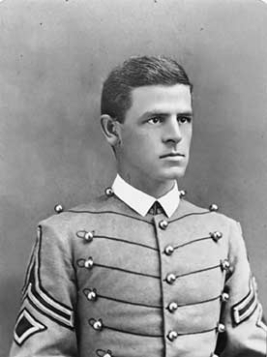
Mills was born in New York City on May 7, 1854. He also attended school in New York, including the College of the City of New York, before receiving his appointment to West Point and reporting on July 1, 1874. After graduation, Mills served in the Department of Tactics at USMA for six months before joining the 1st U.S. Cavalry Regiment at Fort Walla Walla in the Washington Territory. Records show that he was actively engaged in scouting the frontier in Washington, Idaho, Montana, Dakota, Wyoming, and Arizona for six years. In August 1886 he was appointed professor of military science and tactics at the South Carolina Military Academy (a predecessor to The Citadel), serving there for two years before volunteering to rejoin his troop at Fort Custer, Montana.
He was promoted to first lieutenant on January 23, 1889 and appointed regimental adjutant of the 1st Cavalry on October 1, 1890, holding this post for the next four years. He participated in the Winter Campaign in 1890-91 against the Ghost Dances of the Sioux and was serving as an assistant instructor at Fort Leavenworth, Kansas when war with Spain was declared. He then went to the mobilization camp at Chickamauga Park, Georgia and was appointed a captain of the U.S. Volunteers on May 12, 1898. During the Spanish-American War, Mills served with the 2nd Brigade, Cavalry Division, Fifth Army Corps in the Santiago (Cuba) Campaign and participated in the battles of Las Guasimas and San Juan. On July 1, 1898, Mills was shot in the head by a 7×57 mm Mauser cartridge during this last battle and temporarily blinded. For his gallantry at Las Guasimas, he was recommended for promotion to brevet major, and for the same at San Juan, he was nominated for a promotion to lieutenant colonel.
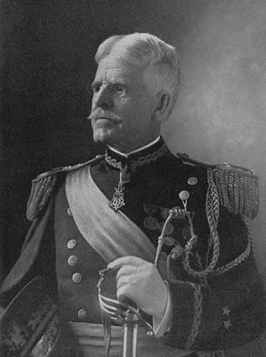
On August 22, 1898, while still recovering from the effects of his head wound, Mills was appointed Superintendent of the U.S. Military Academy. When the appointment came through, Mills’ rank in the regular service was still that of “first lieutenant of Cavalry,” which explains the rank noted in the Register, although he was quickly promoted to colonel upon assuming the posting, as the USMA Superintendent position carried with it this automatic rank at the time. According to Brigadier General William C. Brown (Retired), Class of 1877, who wrote Mills’ memorial article for the 1917 Annual Report of the Association of Graduates, the jump from O-2 to O-6 “was without precedent and caused at the time much comment in the Army.” It is suggested that President William McKinley played a key role in securing Mills’ appointment as USMA Superintendent as a reward for his battlefield heroism.
Mills assumed his duties as Superintendent on September 19, 1898 and served in this role for eight years, a consecutive tour that is only exceeded by Brevet Brigadier General Sylvanus Thayer, Class of 1809, the “Father of the Military Academy.” Given this length of time as Superintendent, Mills was able to enact several important changes at West Point. Perhaps most significant, he tackled the practice of hazing, saying in his first Annual Report of the Superintendent, “In recent years a system of interference with new cadets, or hazing, has come into existence at the Academy which is harmful both to the name and work of the Academy, and in cases has been carried to a cruel and brutal extreme.” In the years that followed, Mills made it his mission to show the Corps that “neither brutality nor harshness” were needed for subordination and discipline. He did this by authorizing more cadet privileges, rewarding those who demonstrated good conduct. In his last Annual Report as Superintendent, Mills wrote, “Hazing has been entirely absent and the spirit which in former years prompted it has in a great measure disappeared.” One of the cadets likely influenced by Mills’ leadership philosophy was Douglas MacArthur, First Captain of the Class of 1903.

Mills also led the Academy during its centennial celebration and authorized the 1903 plan for the decade-long expansion of West Point. Regarding this last point, Mills challenged the architects bidding for the expansion contract to come up with a development design that would progress along both utilitarian and aesthetic lines, providing suitable buildings to handle 1,200 cadets and positioning these buildings in a manner that would beautify the West Point landscape, setting it on the path to be recognized as a National Historic Landmark decades later. A year after authorizing the 1903 expansion plan, Mills received his first star. He left the Academy as a brigadier general and took command of the Department of Visayas in the Philippines. After commanding the Department of the Gulf and serving as a member of the General Staff and President of the Army War College, Mills was assigned as the chief of the Division of Militia Affairs and the Militia Bureau, receiving a promotion to major general in July 1916 but dying in uniform just two months later.
While there isn’t any list in the 2025 Register of Graduates detailing which Superintendent made the greatest impact on the Academy, should there be one in a future Register, a case could be made that Mills’ name should be on it (but, of course, Thayer’s name would still be at the top).
[Photo: 1. top right: Mills receiving dignitaries at West Point circa 1902, 2. top left: Mills as a cadet. USMA archives, 3. right: MG Albert Mills, seen here with the Medal of Honor he received for his bravery at the Battle of San Juan Hill near Santiago, Cuba, on July 1, 1898, USMA archives. 4. bottom left: Mills rests in the West Point Cemetery (Section IV, Row E, Plot 77). Photo: Rebecca Rose/WPAOG]
This article was originally published in the Winter 2026 edition of West Point magazine. View the archive of past issues here.