

By Jane Anderson, WPAOG staff
On May 5, special invited guests watched as the second-floor rotunda of the Jefferson Hall Library and Learning Center was dedicated as a permanent forum for intellectual exchange in honor of William “Bill” Roedy ’70, a U.S. Military Academy grad who broke Cold War barriers with media culture and epitomized leadership in global health.
Made possible by a generous gift by Bill and Alex Roedy, the rotunda was named also in memory of Roedy’s father, Colonel William H. Roedy Sr. ’40, a veteran of WWII and the Korean and Vietnam wars. Colonel Roedy was awarded the Legion of Merit and the Bronze Star. The Roedy Rotunda’s programming offers space for dialogue and rigorous inquiry to help develop leaders of character for the Army and the nation.
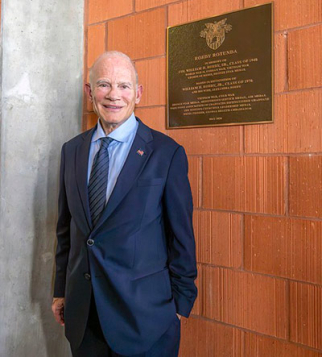
“Today’s dedication is more than the naming of a beautiful space within Jefferson Hall,” said Mark Bieger ’91, president and CEO of the West Point Association of Graduates (WPAOG). “It is a moment to recognize a legacy of service, leadership, and generosity – values that define West Point and that have been exemplified throughout the life and career of Bill Roedy through his shared experience, shared service to our great nation, and shared values.”
At the dedication, Roedy introduced the friends, family members, and classmates who were gathered at the Rotunda, and spoke fondly of each of them. He explained that he had been a “Century Man” during his cadet years, marching off 100 hours of punishment in Central Area. Reflecting on the soon-to-be-unveiled plaque naming the Roedy Rotunda, Roedy wanted to remind cadets that, “If I can make it from the bottom of my class to the center of the library, anything is possible.”
From the Academy to MTV
Roedy’s career path reflects his lifetime of service, both in and out of uniform. After graduation from USMA, Roedy volunteered for and fought on the front lines in Vietnam (“We joined as heroes and left as anti-heroes. We didn’t start the war; we just moved to the sound of cannons,” he said at the dedication) and qualified as an Airborne Ranger. He went on to command nuclear missile bases as part of NATO; during his military service, Roedy received the Bronze Star, Air Medal, the Vietnamese Cross of Gallantry (with Silver Star), and the Meritorious Service Medal.
Switching careers in the late 1970s, Roedy graduated from Harvard University with an MBA. He was a trailblazer in the early years of cable television at HBO, and then became chairman and CEO of MTV International (MTVNI) during the height of music-video fandom. From 1989-2011, Roedy built a global operation of 200 channels and 20 brands (including MTV, Nickelodeon, and Comedy Central) in 200 countries, reaching two billion people and launching the most channels in television history. Notably, Roedy helped bring American music far beyond the U.S. borders—even punching through the Iron Curtain to bring music to the Soviet Union. “When Reagan said, ‘Tear down this wall,’ I listened,” he said. “Missiles became music, and the Iron Curtain became a red carpet.”
Still, the impact of the Cold War reverberated decades later in the library during the rotunda’s dedication. The inaugural programming on the library’s second floor explores that consequential time from 1946, when Winston Churchill first coined the phrase “Iron Curtain,” until the Berlin Wall fell in November 1989.
Roedy’s skills didn’t stop with business; rather, they expanded into global health when he founded and chaired the MTV Staying Alive Foundation, the longest multi-media campaign to fight the AIDS epidemic. Not one to rest, Roedy was appointed the first Ambassador of UNAIDS, was a founding member and chair of the Global Business Coalition on HIV/AIDS, was appointed the founding chair of the Global Media AIDS initiative, became the chair of amfAR (the Foundation for AIDS Research), and was appointed the first envoy for the Global Alliance for Vaccines and Immunizations (GAVI), rising to vice chair in 2018, according to his website.

In addition to his military accolades, Roedy was named one of the WPAOG’s Distinguished Graduates in 2020. He also has received an Emmy Founders Award, amfAR’s Award of Courage, the Doctors of the World Leadership Award, and the U.N. Global Citizen of the Year Award. In 2015 the Cable Hall of Fame inducted Roedy, and in 2024 America’s National Churchill Museum at Westminster College awarded to him the Winston Churchill Leadership Medal. He also served as a member of the West Point Ready Campaign Cabinet.
West Point reflections
Before the Roedy Rotunda plaque was unveiled at Jefferson Library, Roedy pointed out his appreciation that the rotunda overlooks the Plain: “The Plain is where we take our oath to serve; it was our training ground.” He recalled how, as a cadet, he would come to the library to read the hometown newspapers. Now, when he returns to West Point, he reflects upon the six statues that surround the Plain: Thayer, Grant, MacArthur, Eisenhower, Washington, and Patton. The character and career of Patton made the biggest impression on him, Roedy said. “For me, Patton is an inspiration. He was aggressive, creative, and relentless…I took those lessons when we were moving MTV into Europe.”
Other lessons he learned at West Point, Roedy said, were to be “first on the battlefield, last to leave; and quick to take blame, slow to take credit.” He strives to live by his class motto, “Serve with Integrity,” and “Duty, Honor, Country.”
His legacy cements those values, said Lieutenant General Steven Gilland ’90, 61st Superintendent of USMA. “Bill sees service as a moral duty, and he is a rare person who has made a difference in the world,” Gilland explained at the dedication. “The generosity of Bill and his family is not simply financial support—it is a statement of belief in West Point’s mission.”
West Point is fulfilling its mission better than it ever has, operating at the top level, according to Roedy. “Duty, Honor, Country—despite the current turmoil and divisions in our country, those words hold a firm belief in America and hope for our future,” he said. “Talk to a cadet, and you discover their can-do spirit, their sense of duty, their grit. They represent the youth of America and are prepared to serve right out of the gate. They are positioned to be our heroes of tomorrow.”
And as those cadets prepare to lead others at a time that’s nearly as volatile as the Cold War era, places like the U.S. Military Academy become even more crucial, Roedy concluded.
“Amid the world’s complex challenges, this institution has to be supported at all costs,” he said. “The physical grounding of values at West Point is as solid as the granite that makes it up.”