
Modernizing the Sky
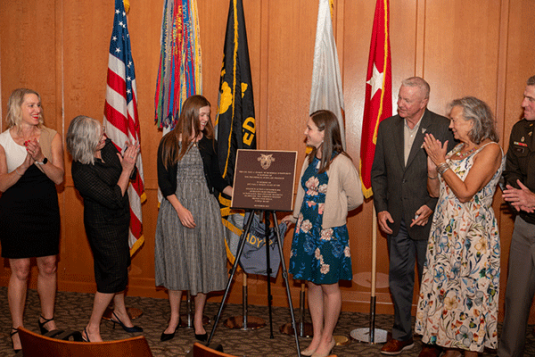
As the Academy undergoes significant facilities modernization on the ground, the airspace above it is evolving just as quickly. Across West Point, the Robotics Research Center has activated leaders, cadets, academic departments, and Garrison elements to make drone operations an immediate capability rather than a future goal.
As the character of warfare evolves—shaped in part by lessons from the war in Ukraine—the Army is accelerating innovation to ensure its formations can adapt. At Keller Army Community Hospital (KACH), that adaptation is underway. What began as a research collaboration with cadets is now turning cutting-edge drone technology into practical tools that could help medics move faster, reach farther, and ultimately save more lives.
Birth of Project MARS
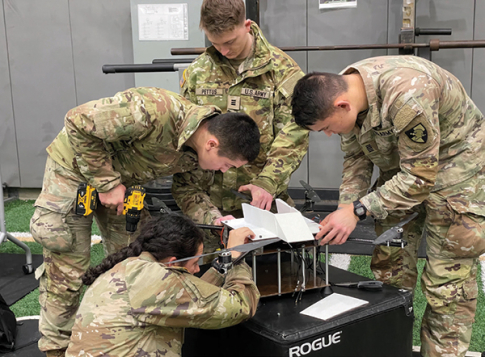
Inside cadet labs and across the training areas of USMA, a new concept has taken shape: Project MARS, the Medical Autonomous Resupply System. The idea is simple but powerful: explore how to deliver medical supplies via small Uncrewed Aircraft Systems (drones) when terrain, distance, or enemy activity makes traditional resupply difficult or dangerous.
In April 2025, a small team within the Robotics Research Center launched a proof of concept—flying medication a short distance from KACH to the United States Military Academy Preparatory School (USMAPS), an ideal proving ground without on-site medical facilities.
Cadets Rising to the Challenge
For cadets, the challenge was anything but simple. Drone operation requires careful coordination. Routes cross public roads, communication links must always be maintained, and safety measures must remain in place, including pausing traffic to ensure a secure flight path. At the same time, cadets were deepening the logistical and technical aspects of the mission.
“It was the first time this happened at West Point,” explained COL Joe Davis, head of the Robotics Center. “So everything took a hyper-conservative approach.” Still, the mission succeeded. The drones flew autonomously. The medication was delivered. And a concept moved one step closer to reality. From there, the drone program at West Point has expanded quickly.
Expanding into Interdisciplinary Capstone
This year, Project MARS has grown into an interdisciplinary senior capstone, bringing together cadets from the Departments of Mechanical and Aerospace Engineering (MAE) and Electrical Engineering and Computer Science (EECS). What began with off-the-shelf systems has evolved into cadet designed aircraft built to carry several pounds of medical payload while balancing range, speed, and battery life. They are moving beyond one-time drone demonstrations to embedding a system of regular, ongoing drone operations.
The capstone is establishing a repeatable delivery route from Keller to the TMC in Pershing Barracks, where medications could be delivered multiple times a day. Unlike earlier tests, the drones will land, be received, and return along a controlled path—mirroring how the system might function in a real operational environment.
“Building MARS has been great exercise of engineering-in-practice, with a client’s requirements but also a budget and doctrine and timeline to manage. We get a chance to apply our skills to a relevant capability gap: a low-cost and modular platform certified for regular beyond visual line of sight deliveries. In the process, each member has had a chance to lead our multidisciplinary technical team. These skills translate directly into military leadership but also business leadership. I’ve especially appreciated the opportunity to work with SFC White and the KACH Team, who have been instrumental in creating the conditions for this project to happen. With their help and West Point’s endorsements (including a brief directly to the Superintendent!) we are excited to see MARS conducting deliveries by the end of the semester!”
—CDT Jacob Crossman ’26
Achieving Regulatory Milestones
In January, USMA reached a major milestone: a Certificate of Authorization from the Federal Aviation Administration, delegated through the U.S. Army Aeronautical Services Agency. The approval allows Visual Line of Sight drone operations across West Point through January 2028.
“This is a pivotal moment for Project MARS and our vision for the future of military healthcare,” said KACH Commander COL Sean J. Hipp. “FAA approval allows us to move beyond theoretical planning and into practical application.”
“The groundwork is now in place to make this process routine,” says Davis. “The broader purpose is telemedicine—once we can conduct these missions routinely in Garrison, we can build Army confidence in aerial supply of all kinds. We won’t get there if we don’t start doing these operations today.”
Integrating Drones into Curriculum
For cadets, the shift from theory to execution is happening. This transition is not confined to a single project. Beginning with the Class of 2027, drone development has become a core element of the USMA curriculum in the AI105 course, mandatory for all plebes.
“Roughly 1,200 cadets go through that course per year,” says Davis, “and they are working in groups of two to build drones. We build 300 drones per semester. Ultimately, we will integrate these drones into summer training.”
EECS also offers CY305 Technology Innovation and Emerging Warfare for juniors. In this course, students use the same drones but integrate more advanced technology. For example, they may add an onboard processor to enable object detection through the drone’s camera system. This allows cadets to identify targets, coordinate call-for-fire exercises, and operate drones equipped with grenade-dropping mechanisms. These drones are more advanced and employ practical operational significance.
To this end, every cadet will graduate as a leader with a full understanding of the technology they will be required to use. That understanding matters. In modern conflict, drones are no longer optional—they are central to reconnaissance, logistics, and battlefield awareness. In today’s conflicts, they account for the vast majority of battlefield casualties. Preparing cadets to operate in that environment is no longer forward-looking; it’s immediate and critical.
Continuous Improvement and Integration
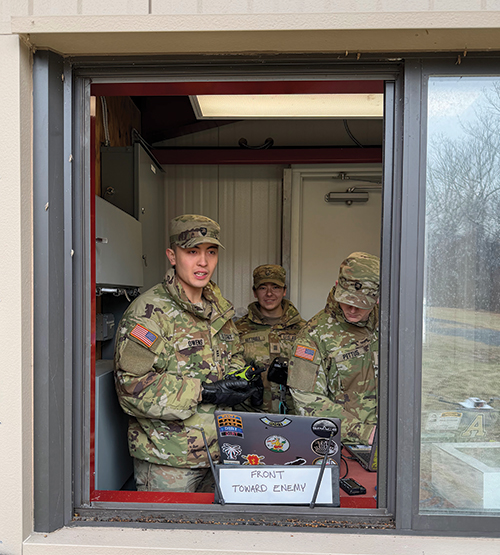
“We will constantly be improving the program,” says Davis. “Ultimately, we are hoping that this is a win for everybody. The cadets get the opportunity to learn how to build them, how to fix them, how to operate and employ them tactically in training. The Robotics Research Center will perform quality assurance and integrate higher technical capabilities where necessary. And then, we hope to find homes in the Army for these drones. There are units all over the Army that need drones.”
This is a pivotal program at West Point and a powerful way to connect cadets’ academic efforts directly to their contribution of military service.
Nothing New Under the Sun
Artificial intelligence technology is now required at the tactical level. The drones fly. The systems improve. The mission advances. But across generations, one thing hasn’t changed. Like any good cadet-led effort, it comes with a familiar reality: Give cadets something new, no matter how advanced, and they will find a way to break it. Sometimes by flying it into a tree. Sometimes by colliding mid-air. Occasionally, in ways no one saw coming, by lithium batteries tumbling out of the back of a tactical vehicle and starting a fire.
The difference now is that they don’t just break it—they fix it themselves, improve it, and send it back up again.
To learn more about the Robotics Research Center, please contact james.brandenburg@wpaog.org.