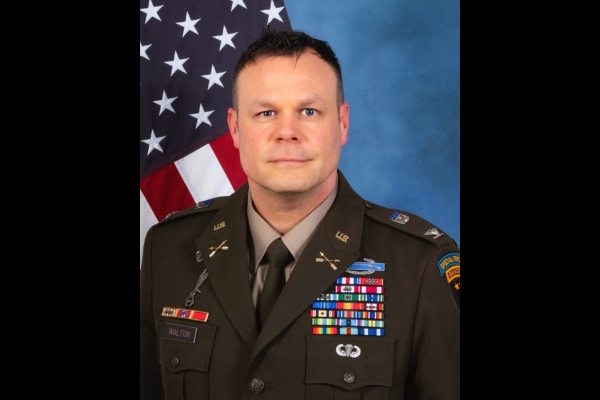
On November 21, 2025, the West Point Association of Graduates (WPAOG) presented the 2025 Alexander R. Nininger Award for Valor at Arms to COL Kyle Walton, Class of 2001.
On April 6, 2008, in Afghanistan’s desolate Skok Valley, then-CPT Walton heroically distinguished himself as the ground force commander of Operation Detachment Alpha 3336, 3d Special Forces Group (Airborne), Special Operations Task Force-33, Combined Joint Special Operations Task Force-Afghanistan when his unit encountered extremely accurate machine gun, sniper, and Rocket Propelled Grenade fire in all directions from a numerically superior Hezebela Islami Gulbadin (HIG) insurgent group. Walton and his unit were on a mission to kill or capture a Joint Priority Effects List target of HIG. After inserting via CH-47 into the objective area at nearly 10,000 feet, Walton led his element through a fast-moving stream and began the climb up the ice-covered mountain toward the objective. Approximately halfway up, the insurgents engaged, critically wounding one ODA 3336 member and several Afghan commandos and killing the detachment’s interpreter. With total disregard for his own personal safety, Walton exposed himself to deadly fire in order to pull his critically wounded teammate back to a semi-covered position and then continued to maintain effective command and control of five different maneuver elements while repeatedly engaging numerous HIG fighting positions. While pulling more casualties to cover, the tip of his rifle barrel was shot off, but Walton, knowing his weapon was no longer accurate beyond a short distance and despite being impacted by two rounds to his helmet, courageously continued to identify targets for other soldiers to engage. As the situation deteriorated and the casualties mounted, Walton realized that his entire element was in danger of being completely overrun and relayed this information to his headquarters, requesting the placement of danger close attack helicopter and fixed-wing close air support on all known and suspected insurgent positions and authorizing the use of 2000-pound bombs to be dropped almost directly on top of his position in order to prevent insurgent forces from overrunning the American and Afghan elements. His audacious decision allowed just enough freedom of maneuver to evacuate all casualties down a 60-foot cliff in preparation for medical evacuation.
Throughout the six-and-a-half-hour battle that saw more than 150 insurgents killed, Walton’s unwavering combat leadership and poise under fire inspired all under his command and was directly responsible for saving the lives of U.S. and Afghan soldiers. For his actions during the 2008 Battle of Shok Valley, Walton received the Silver Star, the United States Armed Forces’ third-highest military decoration for valor in combat.
Speech
Distinguished guests, General officers, Classmates, and members of the Association of Graduates. Thank you for this honor and recognition for our team and class. It is truly a surprise to be standing before you and the Corps of Cadets. I do not think I’m worthy of this. I will only accept this award on behalf of ODA 3336, 3rd Special Forces Group, and the class of 2001, and in particular, my classmate and roommate, Drew Pearson, who was killed in Iraq in April of 2008.
Please take a moment to remember him, and our other fallen comrades and classmates, and join me in a moment of silence in their honor.
Thanks so much to my wife Elizabeth, my parents, and my three children for allowing me to serve alongside you all these years, for everything I’ve put them through, and for coming here to help me finish out my career as it all began—with the Corps of Cadets.
They asked me “what do you hope cadets will take away from your visit and what lesson do you want to impart to them—in just a couple minutes after lunch. I am no orator nor speech writer so please bear with me. This is what I wrote in response:
Well, first, I hope they know, that if it were within my power to release them from the Parade on Saturday, I would do it. Second, if it were in my power also to petition for commutation of their hours, I would do that too, on behalf of Drew and the Class of 2001.
The President of the AOG and I tried, but the parade was a bridge too far. So, General Garcia—What will it be? Will you set these cadets free!
[RESPONSE FROM COMMANDANT OF CADETS:]
That said, I think I would like to leave the Corps with a message of faith, hope, and encouragement in turbulent times. I hope it will be useful, and worth these few moments together today.
I would ask, how many of you are sitting here today, under the gun, falling short, time after time, feeling like you’re not measuring up?
You continue to strive, not knowing if you’re coming back after TEEs, or if you have what it takes to make it…. maybe even one more day.
Maybe some of you are having the worst day or week or month, and are thinking hopeless thoughts about academics, that next physical challenge, this place, or even your lives.
The Old Grads who have come before you…. We have been there as well, and you too were made for a day such as this. You are here for a reason. Do not quit! You will get through this together! Ask for help. You will get it!
We have all lost friends, teammates, or classmates, to something more tragic than combat—to hopelessness, and to succumbing to this world and the evil which is in it.
I want to give you some important encouragement which may help. It’s just my perspective and obviously not the policy or position of anyone else…. but it is a hard learned lesson. It has served me well, through various units, over more than 10 deployments, under fire, and in some truly “come to Jesus moments,” in and out of combat. I think the Battle of Shok Valley, which I’m here this week to talk about, was one of them—literally.
This message underpins a guidepost of moral clarity, a wellspring of strength and resilience, and the Cornerstone of dedication that drives many high-performing warriors. It is how to never be alone. How to find the will to carry on, and to maintain hope. How to discern truth, when its very existence may be under assault. How to never quit. In a word: Faith. Faith in your training, faith in your teammates, faith in your nation, faith that you were absolutely meant to be here, at this time and this place—but mostly faith in the Lord—and that you will never be alone in this world.
Suicide, alcoholism, addiction, sexual misconduct, drugs, pornography, hate, moral and spiritual injury, these are all things which take away from our force and plague the veteran population and our families. Some of these are things may attempt to fill the void we may feel in our hearts…. Regret, pain, sorrow, loneliness, uncertainty, and no-win situations—you will experience them.
How do we be resilient—that is to say, how do we bounce back from defeat, time and time again, and still have enough left to arrive to the battlefield and to win, against those who hate us and our nation?
We cannot do it alone. That much I know. Strength—real strength, providence, luck, where do they come from? None of them come from within. The Lord loves and has a plan for each and every one of you. I’m here to promise you, there is hope and it is eternal. You will find it here, and you will find it on the battlefield, as I did—if you seek the Lord, you will find Him.
My advice—don’t wait.
We are counting on you to go forward, and to fight, and to win. You will be tested again and again, and perhaps against overwhelming odds, surrounded, outnumbered, about to be overrun. You will win…. but Understand, you cannot do it alone. And, any successes you may have, they are a result of a team, and a team of teams, standing alongside you. They are not yours. Give them the credit they are due, each and every chance you have as an officer—and have faith.
If you feel the calling, I would just ask you to say a silent prayer right now and ask God to come into your lives, and to lead you along the rest of this great journey which you’ve begun at West Point.
It’s a simple as that. A leap of faith, forgiveness, letting go of yourself, and all the weight that you’re holding onto, and submission to something greater than yourself.
This will sustain you, your troops, and your families. This is the secret of all the great warriors I know—submission to a greater cause, and a greater power, no matter the cost.
Lean on and support each other, and you will succeed as a class, now, and forever.
You are the absolute best and brightest of this nation…and the exact kind of selfless servants and warriors that we want out there representing us. We are all standing behind you!
May the Lord Bless you and Keep you and the Long Gray Line. ‘Til duty is done—2001.
Q&A With COL (R) Kyle Walton ’01
Q&A With COL (R) Kyle Walton ’01, the 2025 Alexander R. Nininger Award for Valor at Arms recipient
1) Talk about your path to West Point? Why did you want to go to USMA? What was the 47-month experience like for you?
First, thanks so much for hosting me. This is a huge honor and I’m truly surprised and honored to accept this on behalf of the team and our classmates from the class of 2001, in particular, my roommate Drew Pearson, who was killed in Iraq on 30 April 2008, just days after the Battle of Shok Valley. I don’t want this to be about me but about our class and the team, and the Corps of Cadets.
My father was a paratrooper in the 82ND Airborne. As a child I decided early on that I wanted to do the same, attend West Point, and become a Green Beret. I had the standard pathway in high school but scrambled during the last two years to meet all the requirements and appointment to West Point. At West Point, I wouldn’t say I was a standout in any particular way. I was recruited for football and track but did not make either team, which was my first real exposure to failure and resilience—valuable life lessons. Given the academics, it was a blessing in disguise. During Beast Barracks I saw a Green Beret, COL David Jesmer and asked him, “how do I be like you.” He responded, “join the combat pistol team and study Arabic.” I would go on to major in Arabic and Spanish, traveling to Egypt and Tunisia, shoot on the pistol team, do Sandhurst, and represent my class on the Honor Committee. I was a small fish in a big pond and would not have made it through the rigorous academics if not for the help of my classmates in H-1 and B-2. I did not win any academic awards for sure, and was nearly taken out of commission by Discrete Dynamic Systems, Physics, and Chemistry, not to mention Arabic for a majority of cadet life. Tough, demanding, and caring Arabic instructors like Dr. Rajaa Chouairi, COL Mark English and others taught critical lessons and skills, which bore fruit on the streets of Al Fallujah, Iraq and imparted to me a love of languages and other cultures. I was probably their worst student, but their language skills were a direct impact later in life, on myriad occasions.
My singular focus was on branching Infantry, being assigned to the 82ND Airborne, and becoming a Green Beret, and my GPA was just good enough for that. Ironically, I would follow in the footsteps of several of my instructors and coaches in the airborne, special operations, and the Attaché world. I remember most vividly the lessons from these folks during Desert Storm, Blackhawk Down, Panama, and Grenada. In short, West Point was a struggle in some areas and others came naturally. It was a team effort through and through and I’m excited to be back here with the opportunity to visit many of my classmates.
2) When was the last time you were at West Point. What sort of memories will your visit evoke?
I was able to break free to attend our ten-year reunion in 2011, but it was a short trip in the middle of operations, so it is a blur. I haven’t had the opportunity to visit West Point since. I’m married now with three young children. I have no idea what sort of memories this visit will evoke, as I’ll be on the other side of the parade field, so to speak. I imagine linking up with classmates from 2001 will be just as it was when we left—individuals bonded by shared experience, struggle, and great memories during the most formative years of our lives and our military careers. I imagine visiting West Point will be different with children, as they will have the opportunity to share the sights and sounds of the Corps and to see an Army football game.
3) What was your time in the Army like prior to the 6 April 2008 Shok Valley firefight? How many times had you been deployed? How did your past deployments contribute to your reaction to and performance during the Shok Valley mission?
I think our class experience in the Army has been completely mission focused, since graduation. I had three deployments, two as a platoon leader in the 1/505 PIR, 82ND Airborne, and one as the USASOC HHC XO prior to arriving to an ODA in 3RD Special Forces Group. We were in the field at Fort Benning on September 11, 2001. They asked for anyone with family in the World Trade Center to get on a HMMWV. Once it left, they told the rest of us that the WTC was destroyed by terrorists and that we were now at war. We continued the live fire exercise and only received sporadic news for several days. My Ranger buddy at IOBC, Pete Villalobos, was one of the Rangers from Somalia, who taught me, many times from a fox hole, under night vision, fieldcraft and tactics which would pay dividends later. I think most of us fully expected to go to combat prior, but the training for sure took on an entirely new level of intensity and seriousness.
When we returned a week later from the field, the world was very different. Our primary concern in Ranger school was that we would get left behind and not deploy, which was exacerbated by news of the 3RD Ranger Battalion’s parachute assault into Afghanistan. Shortly thereafter I arrived at B, 1/505 PIR, with my classmate John Martinko, the very same unit my father was in decades prior. Mike Phillips and Rob Swartwood, ’01, from Beast Barracks, were also in the same battalion. We deployed to Khowst Afghanistan, attached to a Joint Special Operations Task Force, hunting high value targets on the Afghan-Pakistan border. My company commander, CPT Chris Cirino, also a Ranger Battalion alumnus, led from the front in Afghanistan, and later in Fallujah. I learned much from his style and my platoon sergeants’ tactical acumen, as we again hunted high value targets, night after night. Fallujah was obviously a significantly higher level of intensity and the battalion and platoon excelled in myriad firefights.
At USASOC, my commander was MAJ Jim Spivey—a detachment commander in C/3/3RD Special Forces Group. The unit was well-known for the Battle of Debecka Crossroads in Iraq. I met several of the individuals involved while at USASOC, and would later join their ranks in the exact same company. I appreciated the investment he and they made into my professional development and preparation for selection and for Special Forces. During my time at USASOC I was able to deploy and assisted as a CJSOTF-A battle captain during Operations Redwings. The lessons learned in Afghanistan and Fallujah, all working side by side with airborne and special operations joint task forces, I think well-prepared me and our team/s for subsequent operations. The integration of close air support, communications, and working by with and through larger and larger sized indigenous forces, like the Afghan Commandos, were things I think evolved and improved over time as the war went on.
4) What training and/or experiences at West Point would you say prepared you for the events of 6 April 2008? Can you address this from both a summer training (CTLT, CFT?) and an academic year (CMDT hour, MS300, brigade leadership?) perspective? Ultimately, what got you through the six-and-a-half hours of hell that the accounts of your encounter with the HIG insurgents describe.
During several military science classes, and during summer training, we were exposed to Rangers and Special Forces who were involved in Black Hawk Down and in Operation Desert Storm. Two Special Forces NCOs trained our platoon in during Buckner as well. The individual lessons learned, TTPs, and anecdotes from these individuals formed what we thought of combat, which was otherwise largely informed by Vietnam-era stories and movies. Nothing can totally prepare you to be outnumbered, surrounded from elevated positions, and in danger of being overrun, with rapidly deteriorating weather and prospects for close air support. God and your team are what get you through those days at work, period. Exactly zero things are individual efforts in the serious battles. You can always tell when you’re facing a well-trained and determined enemy, vice a disorganized force. Unfortunately, we were unable to fast rope onto the rooftops at night, which was the original plan. Climbing the mountain, at high altitude, wet from the river helicopter infil, and through patches of snow, with a narrow weather widow was going to be a tall order, but those were our orders and the nature of Special Forces—the most difficult targets in the most difficult circumstances. From initial contact it was clear that this one was different and that we and the fledgling commando force would face a serious challenge.
Stepping back, overall, I was probably an average ODA Detachment Commander. I knew many much better, who I looked up to, like CPT JP Thompson, KIA in 2010 on our third SF deployment in the same unit. Similar to West Point, I was never the fastest, strongest, smartest, etc. I was privileged to be surrounded by truly exceptional people throughout most of my career, even more so in the more elite units, and especially on ODA 396, later branded ODA 3336. This is one of the best takeaways from West Point—it is far better to be a small fish in a big ocean than the other way around. I believe God puts us at a particular point in time and space for a reason. That said, I am not the example of an individual standout—rather I and the circumstances here seem to be the illustration of how regular people can be molded by the Army process, guided by providence, and surrounded by others in a common cause to achieve more than the sum total of their parts. Simply put, the results we see on the battlefield are the sum total of all the individual investments of everyone working towards the same cause, from West Point, until the end of your career and all of the preparation that goes therein. They involve teams of teams, equipment, intelligence, support, other services, and sometimes luck. They are not just demonstrations of individual effort, skill, or quality—at least not in my case.
As a cadet in a Military Science class, listening to a 5SFG ODA commander who was nearly overrun in Desert Storm, and had to call in danger close air strikes, I never questioned whether we would be in combat. I hoped not in a hide sight, behind enemy lines, being chased by Iraqi tanks, however. Ironically, we experienced a similar circumstance, albeit from a different enemy, and in different terrain. The lessons learned during Operation Redwings, Fallujah, and Afghanistan stressed emphasis on communications and contingencies. We had those in spades during Commando Wrath and other missions—and it turned out that we had just enough. For cadets: they should visualize themselves in combat daily and absolutely expect that they will fight. This is why they are here, and to be mentally and physically prepared is a big part of the battle. I think when the training is done, and when we subordinate ourselves to a common cause, a process, and trust in God to get us and our teammates through the inevitable trials, we are as prepared as we can be. That said, what you bring to the fight is all you’re going to likely have—so train hard and bring a lot more capability than you think you will need!
5) In an attempt to summarize the events of 6 April 2008 to readers, could you describe what sounds, smells, sensations, etc. that you vividly recall from the firefight? How would you describe the rollercoaster of emotions you must’ve felt on that day and in the times afterwards?
Clearly, I most vividly remember the myriad acts of heroism from my teammates, which were seemingly non-stop from the first shot until the last: Individuals like Louis Morales and Dillon Behr, severely wounded, continuing to fight, despite bullets impacting all around and on us, for hours. John Wayne Walding carrying his own leg down a cliff during his MEDEVAC. Ron Shurer, Matt Williams, and Dave Sanders’ repeated efforts to help get to our position and evacuate casualties down the cliff. Zach Rhyner being right next to me for hours working close air support. Scott Ford climbing to our position and being hit multiple times. Mike Carter, the combat cameraman, helping to pull casualties back, defend them, and lower them. Seth Howard’s refusing to leave the cliff and providing accurate sniper fire until the end, to cover the CASEVAC. We would likely all be dead without his heroism. Ryan Wallen, Karl Wurzbach, Shawn Mason, Dan Plants, our two intel folks, and many others on ODA 3336 and other ODA teams, including SFC Flynn, who suppressed enemy directly above us, while exposing himself in the middle of the valley below, or our company Sergeant Major, Wallace—who jumped off a MEDEVAC UH-60 into the battle to try and help in any way he could. There are so many Green Berets and others who fought side by side in the shadows. I am thankful for and remember them all, not just the few who were selected for valor awards.
Here are a couple random other things that I remember, but may not be as well known.
In terms of sounds, Brendan Ormond, a new Green Beret arrival to our battalion during the deployment, was the voice in my left headset ear, during the entire battle, as the battle captain, on the satellite frequency, as well as aircraft and their headquarters, while the ODA team was in the right ear. He and the team back at Bagram and Jalalabad vectored all aircraft and assets in the area in support of our force. There were moments of levity, amid the gunfire, back and forth, and he did an amazing job. Explosions, gunfire, aircraft breaking the sound barrier, interpreters, commandos in Dari, Pashto, and Farsi, and two separate radios talking simultaneously, those are the sorts of things during a mission, at least a busy one.
In terms of smells and sensations, one thing I remember, as I imagine many veterans recall from their experiences, was in this battle and others, the smell of JP-8 from the aircraft at extremely low levels, and the smells characteristic of exploding munitions. These are completely foreign smells in the mountains of Afghanistan. Ironically, they brought a sense of comfort and familiarity, like the entire capability of the United States was behind us, even amid a lengthy firefight, which came back to me recently at Joint Base Elmendorf Richardson, Alaska.
There are other things in that battle which speak to the same sentiment of unity, like how many Green Beret units in Afghanistan, cooks included, mustered and were repositioned by Task Force 160 into staging areas to try and reinforce us, but were blocked/delayed by rapidly deteriorating weather conditions. The aviation task force commander was in a helicopter above and ordered his entire battalion into the fight over the radio to try and prevent us from being overrun. The F-15, A-10, and AH-64 pilots, who did nonstop aerial acrobatics to get bombs on target, believed we were dead at one point. Two crews of UH-60 helicopters were riddled with bullets, and some wounded, when while flying under power lines to get to our wounded. One of those took off (as they were shot) as Ryan and I were trying to help Scott into it and had to make another go around. There was some sense of relief once the casualties were off the cliff, though bullets were impacting still, feet away instead of inches away. All of these dramatic instances demonstrate exactly the point that American soldiers and airmen will not allow their own to be hung out to dry or left on the side of a mountain, no matter the personal consequences to try and get them out. Those of us who were awarded valor awards are really accepting them on behalf of these folks who operated in the shadows and made all the difference and on behalf of our wounded comrades and interpreter Edris “CK” Khan, who was killed next to us in the opening salvo.
The most vivid moment I think was the worst point of the battle, as we were in danger of being overrun, I instinctively grasped my only grenade—I said a prayer for God to assist us. “Please God we just need a little help here.” Instantly, a 2000lb bomb, almost directly on top of our position, impacted, blotted out the sun for several seconds, as dirt and debris fell on top of us, and what looked like a gigantic redwood-type Christmas tree flew across the mountain—then we had our break in effective fire to make a move down the mountain. What happened was crystal clear to me. We were not alone on that mountain. The team rallied and the rest is history.
6) You are the fifth recipient from the Class of 2001 to receive the Nininger Award (Randall L. Ashby-2007; Matthew Chaney-2016; Matthew R. Myer-2018; McKinley Wood-2023): Did you know any of these other grads as cadets? Have you spoken to any of them after they have received their Nininger Award? How does the Nininger Award—being recognized for your service during GWOT—relate to the Class of 2001’s motto: “‘Til Duty is Done”?
Yes. I know or knew several of them well, especially Randy Ashby and Matt Chaney and the others to a lesser extent while we were cadets. We never discussed any awards but grew up in the Army together in basic, advanced, and specialized training for Infantry and Special Forces. To be honest, I regard these guys pretty highly and never really consider myself within the same caliber. I would follow any one of them without question. For them, and the other awardees, I was not surprised based on my interactions with them. For me, I am surprised, and I am honored to even be in the same West Point class as these guys or several other 2001 classmates who paid the ultimate sacrifice, like my roommate Drew Pearson, who was killed in Iraq during the same month as the Battle of Shok Valley. I hope that this event is an occasion for us all to remember them and their families and not to focus on me, one team, or one battle a long time ago.
With regards to our class motto, “‘Til Duty Is Done,” it is emblazoned with a lightning bolt and eagle, and sabers, from our march back from Beast Barracks. I think it’s probably the best looking one, so well done to our folks who put it together for the class, and to our classmates who are here making it happen at USMA and the Thayer Hotel. They are representing us well every day and so are our classmates still in uniform across the globe. Rain during that march, as I understand it, historically bodes immediate combat for the plebe class upon graduation. I can speak to the accuracy of that superstition or tradition, at least in our experience. As for what the motto means to me, personally, here it is in a nutshell, as I’ve only now had the occasion to stop and think about it recently as an old grad:
West Point. As an American, this place means much more than a university or even the Army….it is the place where the very ideal and virtue of America is demonstrated and proven, and where old grads can return to see it still alive, even when things outside these walls are turbulent. Cadets come together, regardless of background, creed, or politics, and work together to forge the backbone of leaders of character for the next generation of the Army—and more importantly, the nation. Inevitably, each class is tested—on the battlefield and in other equally perilous environments.
For me the ideal which is West Point is something that I don’t think most of us fully live up to…in our own estimations…. but we believe it…and it gives hope when times are difficult, that our nation and our families put forth men and women to strive here and on the battlefield for an ideal which best represents us all, and everyone who came before us. In short, something that we can be proud of, that truly means something, and that leaves this country better off for our children. Now that I am happily married with three children, this is even more important and clear to me. Duty comes in many different forms, only one of which is combat. To see old grads behind the scenes in the Pentagon and Washington, DC, like Mr. Don Lash ’83—truly fighting the good fight, with honor and integrity, and real personal courage, and to see them out in the world of business, education, government, relief work, and entrepreneurship; it’s clear to me that their duty was not done when they left military service, and that the motto of the Class of 2001 really does justice to more than just our own class.
These are not necessarily the things I thought of in plebe math…but the honor and the virtue of this place and our ideal…. I believed it whole heartedly, and so did my classmates in the class of 2001—it took us through well over two decades of constant combat deployments and many lost Classmates, Soldiers, and friends. We still do.
These aren’t so much lofty ideas I think, as they are what this place and this country is all about. This place doesn’t define us—it defines our nation in a way, in every class. Every state is represented here. Every cadet is chosen to represent their community and their way of life, right here, as warriors and ambassadors, who holistically, represent us all. From the earliest days until now, much is the same—the best things Americans have to offer. It’s forged in doing things that are difficult or uncomfortable, over and over, which is the basis of discipline or duty, at a basic level. It also involves honor and standing up for what is right, when nobody is watching, and being willing to suffer the consequences and sacrifice for upholding our moral and ethical standard.
It’s not elitism, rather those are the kinds of things, the best effort and the best teamwork and the best standards, from your entire class, that are necessary to even make it through or survive this place, much less succeed here. You can walk outside right now and see that at West Point and know that those of us who walked these grounds still have a responsibility to uphold that same ideal, and to keep fighting for the cause of good, and doing our duty, wherever we are. It’s a daily choice, and for the most part, that’s exactly what I’ve seen for the last 24 plus years, and I hope to live up to it too, and to impart even a little bit of it to my children, regardless of their path. That’s kind of what “till duty is done” means to me, as a cadet and still today.
7) With this award, you are being help up to the Corps as “an exemplar of heroism.” What does this phrase mean to you? Furthermore, how do you feel about “representing all West Point commissioned officers who have heroically led soldiers in combat?”
Importantly, I only accept this award on behalf of the larger team and my class. I don’t think I’m an “exemplar of heroism” at all. I did nothing more than every other one of my teammates and the other forces on the ground during that particular battle. Ron Shurer and Matt Williams received the Medal of Honor, Zach Rhyner the Air Force Cross, and many others Silver and Bronze Stars for their performance and valor. Myriad pilots, other ODAs from 3RD Battalion 3RD Special Forces Group, and the Afghan Commandos all acted heroically. Believe it or not, this is actually not uncommon in Special Forces, or in the Army, at least in the experiences I’ve had, which speaks to the quality of men and women who volunteer to do this kind of work. Without the entire team, I have no doubt that few if any of us would have survived. Most missions remain classified. Only the ones which are against overwhelming odds are recognized. Truth be told, no one seeks valor awards or the conditions which seem to beget them. The ODA conducted myriad combat operations before and after Shok Valley which were tremendously consequential in terms of battlefield effects. This mission, however, demonstrates the core values of the Green Berets and of West Point, and the Army, then and now—they never quit, and they never leave a Ranger behind—ever. You see this all the time when you are in Group or the Task Force. It is an American value—not something unique to Special Operations. The crux of this mission was that the team held together to protect casualties which were pinned down against a cliff, even when it became likely that the command element could be overrun.
That said, the real heroes are the ones who lost their lives or limbs or were seriously wounded during that battle, and the rest of the team who refused to quit to save them. The same folks have continued to demonstrate heroism and dedication to duty long after the Battle of Shok Valley, and come together still when the need arises, in order to serve the nation, on and off the battlefield. I certainly am the least among them, and I am proud to call them teammates.
In terms of representing all of West Point, that is a tall order. I don’t think I can live up to that—but I can certainly point back to all the experiences and lessons learned which were imparted beginning at West Point, throughout army training, and continuing forward into battle. I look back and see so many Green Berets, Rangers, paratroopers, West Point faculty, and classmates whose lessons and anecdotes truly shaped the tactical skills and the moral and ethical grounding which contributed to the last 24 plus years of deployments—these are the things which brought all of our troops back home—not my personality, will, or skill. It is appropriate that I began my career here and that this is the place where I hang up my boots. The critical elements which have ensured our nation’s success prior and subsequent to this battle remain the same—the Cadet Honor Code, the Army Values, the Ranger Creed, and faith in our Creator and fellow Soldier. These are the critical foundations for developing leaders of character and for winning, both on and off the battlefield, and for staying with it when times are tough. I think this is part of the essence of our class motto: “Till Duty is Done.” I’m honored to be a part of the Class of 2001, and to receive this recognition on behalf of them, the Green Berets, and our fallen comrades. Thanks to all the old grads who are still doing their duty and being leaders of character, both inside and outside the government, and thanks to the cadets here today who have signed up to be part of the Long Gray Line.