
By CDT Andrew Miller ’27, Guest Writer
“You know you’re having dinner with three generals tonight.”
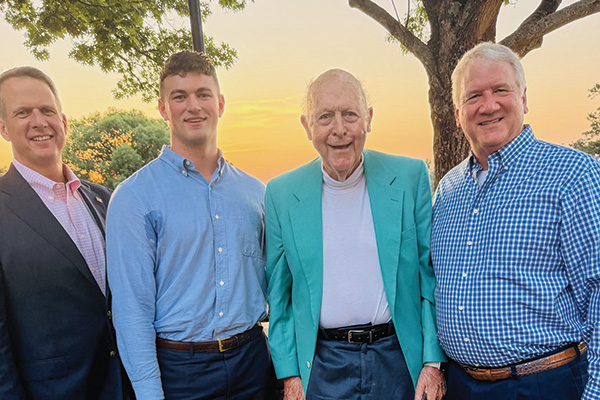
Standing in the parking lot of the Augusta Country Club, I looked up, surprised. I had expected dinner with Major General Perry Smith ’56 (Retired) and his wife, Connor. I had not realized General Smith had invited two additional general officers. Later, I understood that the number of generals mattered far less than the generations of the Long Gray Line they represented.
What I anticipated as dinner with a distinguished alumnus became something significant: four generations of West Pointers gathered around one table, connected by 70 years of Academy history.
My relationship with General Smith began through the Army Lacrosse alumni network. As a current Army West Point Lacrosse player, I connected with him as a former player and alumnus. Although decades separate our time at West Point, lacrosse gave us an immediate bond. The program has changed since he wore the uniform, but its values of family, toughness, and tradition remain strong.
That bond led us to meet in Augusta, Georgia during my Academic Individual Advanced Development internship. I expected to learn from an esteemed graduate, but I did not know how clearly the evening would demonstrate the significance of the Long Gray Line.
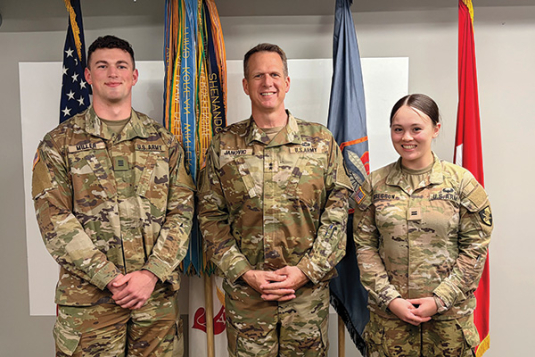
The speaker in the parking lot was Major General Ryan Janovic ’93, commanding general of the U.S. Army Cyber Center of Excellence at Fort Gordon, Georgia. Inside the club, I also met Brigadier General Jeff Foley ’78 (Retired) and his wife, Beth. Soon, we were seated with General and Mrs. Smith. Our cadet experiences began in four different eras, yet the distance between them quickly disappeared.
General Smith opened with stories, including those of Don Holleder, his roommate and close friend. Holleder, Class of 1956, was killed in Vietnam while attempting to rescue wounded soldiers. His courage remains embedded in West Point’s history, and his name lives on at the Holleder Center, the home of Army West Point’s Hockey and Basketball programs. General Smith also recalled serving as the best man at Holleder’s wedding.
As he spoke, General Smith seemed caught between pride and sorrow. He honored the life Holleder lived and the courage he displayed, yet the pain of losing a close friend to such a difficult death remained present. I was moved by the way he remembered Holleder—not merely as a heroic name from West Point history, but as the young man who had been his roommate, teammate, classmate, and friend.
Listening to him, I began thinking about my own class. We live beside one another now, focused on our teams, classes, leadership, and graduation, but our lives will soon branch in different directions. My classmates will serve in different units, travel across the world, build families, and face challenges none of us can predict. Decades from now, the people beside me today may become the stories I tell. That thought was both inspiring and sobering. General Smith’s memories reminded me that the Long Gray Line endures because graduates remember their classmates and preserve their memories.
General Foley’s stories revealed another connection. During his Army career, he served as a Signal officer at an Army installation in Korea. This past summer, I also trained with a Signal unit only minutes from his former unit. My brief experience cannot compare with the depth of General Foley’s service, but it gave me a modest point of reference. His story showed me how the Army carries people across the world and across paths traveled by those who served before them. Different generations may reach the same installations with different responsibilities yet encounter familiar places and communities. The Army is immense, but shared experiences can make it feel remarkably small.
Later, General Janovic gave me advice that I will carry into my final year at West Point: “Take in everything the year has to offer; be present, try new things; and invest in the people around you.” His advice reinforced what General Smith’s stories had made clear. My remaining time at the Academy is limited and valuable. My relationship with my mentors, instructors, coaches, and friends will define my memories of West Point more than any grade, inspection, or requirement. The difficult moments will pass; the relationships will remain.
The Long Gray Line is not symbolic language reserved for ceremonies. It is real, and I saw it around that table—in two Army Lacrosse players separated by seven decades, in General Smith’s memories of Don Holleder, and in the connection between General Foley’s service in Korea and my brief training there. Most importantly, the history and strength of the Long Gray Line was present among the USMA Classes of 1956, 1978, 1993, and 2027 that evening.
For me, the dinner in Augusta was a rare privilege with a readily apparent meaning: West Point connects its graduates through a shared past and common experiences that continue to overlap throughout their lives and service. Being a West Pointer means inheriting the examples of those who came before us, upholding their values, and preparing to guide those who come next. That responsibility lives through the relationships, lessons, and memories each generation passes forward.
CDT Andrew Miller ’27, Company A-1, is originally from Northport, New York. He is a midfielder on the Army West Point Men’s Lacrosse Team, a graduate of Air Assault School, and First Regiment’s A/S3 for the 2026-27 academic year.
This article was originally published in the Fall 2026 edition of West Point magazine. View the archive of past issues here.