By Erika Norton, Guest Writer
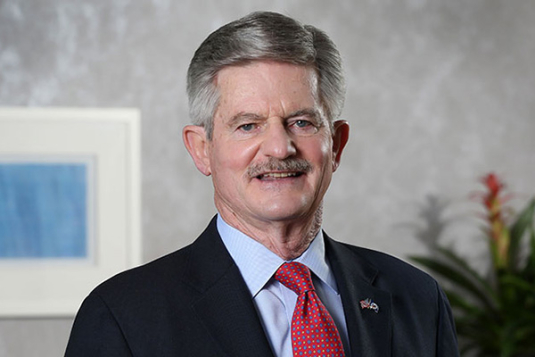
Images of the devastating Palisades Wildfire dominated headlines in early 2025 as flames scorched 37 square miles, claimed 12 lives and destroyed thousands of buildings, making it one of the deadliest and destructive California wildfires on record. For Lieutenant Colonel Jim Cragg ex-’94 (USAR, Retired), this tragedy hit close to home—his literal hometown of Pacific Palisades.
Despite the chaos and devastation around him, Cragg’s West Point training kicked in, and he was able to not only act fast and keep his family safe but also save his home and many of his neighbors’ homes. Cragg saw his community hurting and shifted from emergency-survival mode into long-term incident commander for his community’s recovery. “Life has been a hell for me, my family, my neighbors, and my friends for the last year, but that sense of duty that was instilled in me at West Point, where I can look at this in a positive way and try to see a positive outcome, has kept me going,” Cragg said. “When I drove back into that city every day and it’s rows and rows of what used to be my town, it was hard, and sometimes being able to step into that leadership position helped.” Help also came in the form of numerous West Point graduates joining him in the recovery effort.
Major General Jason E. Kelly ’94 and the debris recovery specialists within the U.S. Corps of Engineers (USACE) were also closely watching the blaze rip through California. “Even before the devastating Palisades and Eaton fires were extinguished, it was clear this would become a recovery effort of unprecedented size and scale,” said Kelly, Cragg’s former classmate. “We knew the U.S. Army Corps of Engineers must be prepared to move fast, meet the moment, and help the people of Los Angeles County get back on their feet.”
On the local level, Cragg had already transformed the local American Legion Post into a disaster hub—the Pacific Palisades Wildfire Community Support Center—treating the area like a forward operating base. There was running water, working bathrooms, electricity, and phone lines to help residents reach family members and stay informed in a world dependent on cell phones and internet access.
A week into the mission, Colonel Eric Swenson ’98, deputy commander of the USACE North Atlantic Division at the time, received word from Kelly that he would be sending assistance. Soon after, Colonel Brian Sawser ’99 arrived, then Colonel Jeff Palazzini ’99 and Colonel Sunny Avichal ’01—all Old Grads and fellow district commanders in USACE with what Kelly described as a shared language, mutual trust, and a bias for action. “It’s a powerful reminder that West Point consistently produces leaders of character who run toward the fire when the nation needs them,” Kelly said.
These three officers commanded the recovery and emergency field offices in Altadena, California and in the Pacific Palisades, overseeing the ground-level execution of the debris-removal mission. In this role, they became the public face of the USACE mission, engaging daily with local officials, news media, and, most importantly, impacted residents. Several more company-level and field-grade officers on the team were also members of the Long Gray Line, supporting operations, community engagements, public affairs, and other mission-essential roles.
With this almost “Avengers-like” assembly of experts on the ground providing tactical command and engaging with affected communities, Kelly said his role was to help represent and empower that team. He was also cognizant of the visibility of this mission, often reminding his team they were “main characters on the main stage” and needed to perform accordingly. The scope of the mission was immense. More than 10,000 properties burned in these fires, and USACE’s job was to clear out all the fire ash and debris from the properties that opted into their services. According to Kelly, early estimates put the mission timetable at more than 12 months.
“We knew we had to challenge ourselves to do better and go faster,” Kelly said. “LA was counting on us and the country was watching.” Now, more than ever, Kelly and his team needed to embody the USACE vision: “Engineering solutions to the nation’s toughest challenges.”
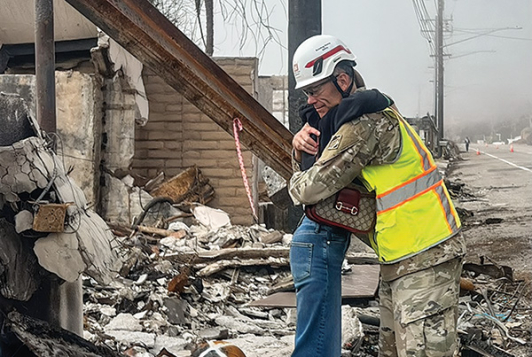
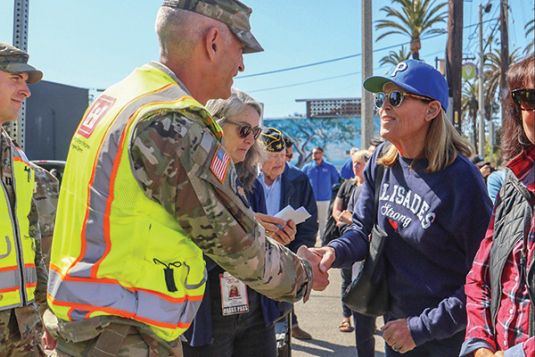
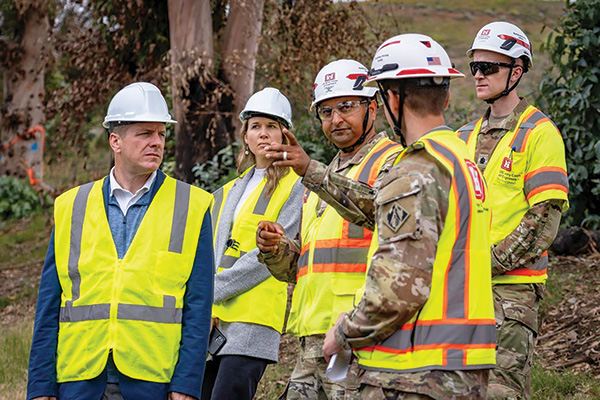
commander of the Emergency Field Office-Pacific Palisades at the time, attended a flag planting ceremony
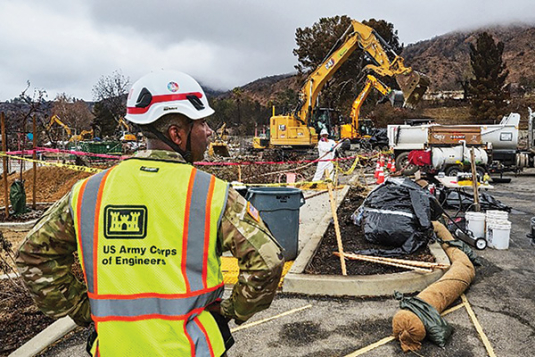
the U.S. Army Corps of En
Cragg welcomed the U.S. Army Corps of Engineers and understood the importance of how visible the Army would be for local residents, encouraging them to be prominently identified as “Army” so residents saw all that the Army can do, not just armed combat.
To beat that 12-month estimate, Kelly said their team had to act with decisive speed and shatter bureaucratic constraints, relying heavily on their “Warrior Ethos” and bringing a military urgency to a domestic crisis. “We seized every opportunity to cut our own red tape and rewrite the playbook,” he said, “ensuring we were moving safely but with unprecedented swiftness.”
“It came down to agility and leveraging a diverse network of expertise,” Kelly explained. “We didn’t just rely on standard procedures; we applied the exact same operational muscle memory and military logistics that allow the Army to project power globally.” By tapping into expertise across academia, private industry, and the military, the USACE team was able to optimize the entire debris removal supply chain, treating the Pacific Palisades domestic crisis with the exact same urgency they had applied to kinetic environments overseas, which allowed them to sustain a record-breaking pace. “At every phase of the operation, we asked ourselves, ‘How can we shave a day, an hour, or a minute off of the timeline, while never sacrificing safety?’” Kelly said. “We asked hard questions about what must happen ‘by the book,’ and where are the opportunities to rewrite the book, so we could shorten the time it takes to get shovels in the ground and ultimately help LA rebuild.” From contracting actions to the establishment of debris haul routes and temporary storage sites, the USACE team moved quickly alongside its civilian partners. “We would rather ‘get caught moving,’ than be seen standing still or waiting for paperwork while communities needed our help,” Kelly said.
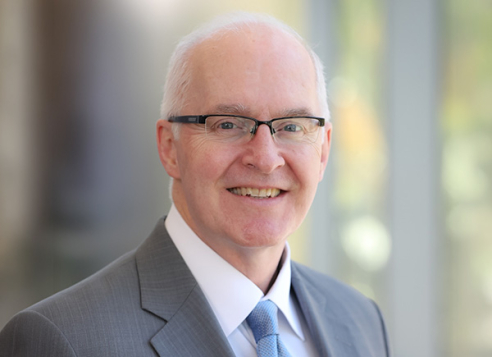
Thanks to this sense of urgency, collective expertise, and bias for action, the U.S. Army Corps of Engineers completed the mission in a record-breaking six months, beating the original estimates by a full six months. “Coordinating a 4,000-person strong recovery effort across two large fire-impacted areas and across a major U.S. metropolitan area that affected tens of thousands of survivors was no small feat,” Swenson said. “Treating it as a system, finding the inefficiencies, working to remove bottlenecks, and using my people skills to compassionately inform, educate, and assist survivors helped me help the federal, state, and local team accomplish the largest and fastest wildfire debris removal effort on record.”
But this was not just an engineering achievement: The humanitarian effort was also critical. At the Pacific Palisades Wildfire Community Support Center, Cragg made sure supporting his grieving community emotionally was a top priority, partnering with UCLA Department of Psychology to create psychological first aid protocol for disaster. The team assessed each victim’s demeanor and needs in order to provide comfort, structure, and hope, then moved them toward insurance and rebuilding. Kelly noted that his team was keenly aware that the impacted communities included many of their own—service members, veterans, Old Grads, military families, and USACE employees—making the mission uniquely personal. Much of his Army career has focused on deployments outside of the United States, what he called the “away game,” so he was grateful for this rare opportunity to deploy stateside in a role that the Army could directly serve and support friends, neighbors, and fellow citizens.
“The Cadet Prayer reminds us to ‘soften our hearts for those who sorrow and suffer,’” Kelly said. “That resonated deeply as we met LA residents on one of the absolute worst days of their lives, ensuring they felt seen and supported.”
Throughout the mission Swenson interacted with thousands of survivors and conducted no less than 50 hours of public meetings in his first 30 days. “It was exhausting and exhilarating at the same time,” he said. “I remain in contact with a few dozen survivors and have had the opportunity to return to LA to celebrate their ribbon-cuttings and major rebuilding milestones.”
While the world-class engineering classes he took at Mahan Hall have been instrumental as an Army engineer, Kelly said it has been the “intrinsic lessons” from his cadet years that have made the difference. “West Point teaches you early on that you cannot survive alone,” Kelly said. “You rely on your squad and your classmates—‘cooperate and graduate,’ as the saying goes—and that translated perfectly to our work at USACE during the Pacific Palisades recovery mission.”
This article was originally published in the Fall 2026 edition of West Point magazine. View the archive of past issues here.