By Jane Anderson, Editorial Manager
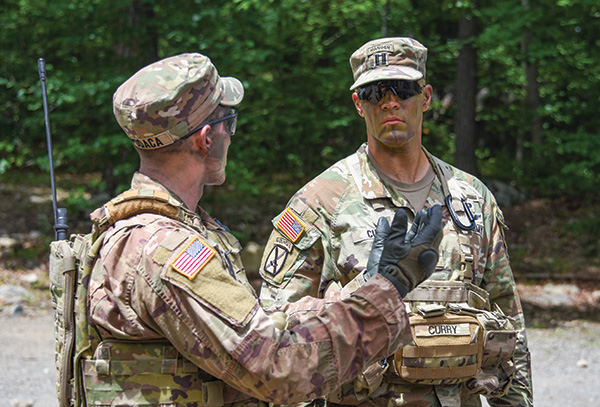
Captain Madison Curry ’20 experienced a unique sort of homecoming this year.
A decade earlier he was a new cadet enduring the six grueling weeks of “Beast Barracks” himself; this past summer he was the officer in charge (OIC) of Cadet Basic Training (CBT) for Task Force Summit, the unit that the Department of Military Instruction validated to train the upperclass cadre who then led the new cadets during CBT. In 10 short years, he went from the subject of a training plan to its author, planning and preparing CBT’s various training lanes (basic rifle marksmanship, land navigation, team live-fire, and more), with the assistance of his fellow OICs and NCOICs.
Training for this year’s cadre began in April at Camp Natural Bridge. Almost immediately, Curry sensed the difference 10 years made. “Being here as a company commander rather than a new cadet, I obviously have more leeway, more freedom,” Curry said. “You don’t get to touch anything as a cadet, regarding setting up your campsites and bay; but this summer, we got to make Camp Natural Bridge our own.” Stepping into a leadership role after having been a new cadet gave Curry an awareness of what the incoming members of the Class of 2030 would remember about CBT and how he and his team could help shape it.
Task Force Summit’s goal, of course, was a fully trained cadet cadre. “My role was setting expectations for my OICs and NCOICs,” Curry said, “but it was the cadet cadre’s and task force lane teams’ responsibility to carry out these expectations.” Curry’s ultimate expectation was that, at some point during CBT, the cadet cadre showed up to a lane, having trained on discipline explained to by the OICs and NCOICs, and executed without being reminded.
Lessons that Curry has learned since graduation translated into the guidance he hoped to provide to the cadre. “Being a new leader requires you to be aware of what you do and do not know,” he said. “It’s easy for a new leader, who doesn’t know what right looks like, to fall behind, but my job is to help them understand why a process works, coach them through the process, and teach them logical planning.” Curry advised this summer’s CBT cadre members to focus on the basics and to remember who they are serving: “The training audience is so new to the Army that the habits you teach them will likely carry over well into their careers.”
Discipline was a major focus for Curry and Task Force Summit in training the cadet cadre. “One of the first things we tackled was structuring discipline using the cadet cadre, to help them ensure that things are running well for CBT,” Curry said. Integrating all the cadet cadre positions, from commander down to squad leader, into that discipline makes for better overall training, he said; an example of that is explaining the roles to the entire cadre before assigning to them their duties and responsibilities for the day.
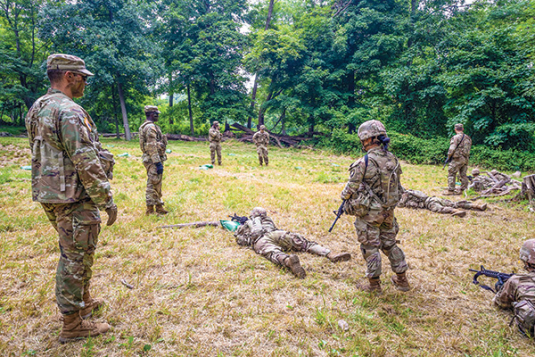
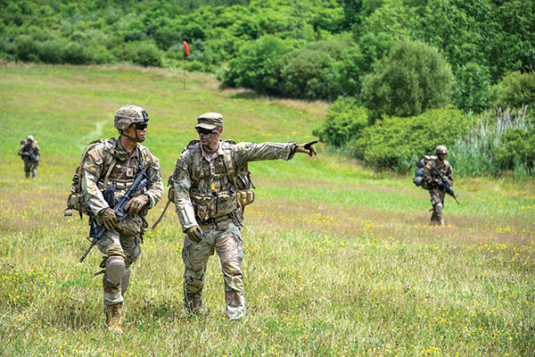
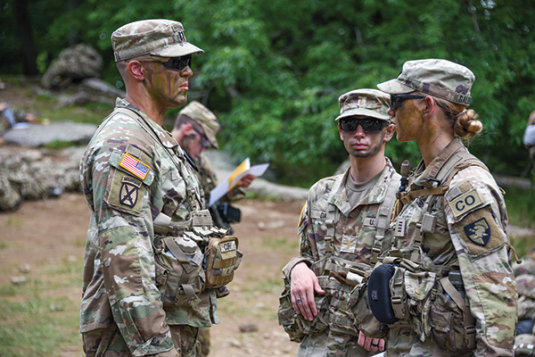
that, in turn, trained new cadets
during CBT.
The expectations for the CBT cadre grew as their training evolved. “You can’t expect a cadet leader to do things a company commander would’ve done, but we could empower these junior leaders to execute low-level missions, such as properly conducting pre-combat checks and pre-combat inspections.” From these initial tests, Task Force Summit ramped up training to a point where the cadre could hypothetically operate the CBT training lanes without task force supervision. Curry and his team also taught the cadre how to conduct detailed planning and solve issues as important as de-escalating conflicts—and as mundane as efficiently moving 150 soldiers through a bathroom. The spectrum of problems that junior Army leaders need to solve is vast, and not all of them can be simulated in training ahead of time. Learning the decision-making process and understanding leader intent and end-states starts as a cadet.
Curry himself learned such lessons at West Point before commissioning as an Infantry officer upon graduation and undergoing the Infantry Officer Basic Leadership Course. He then spent three and a half years with the 2nd Battalion, 3rd Infantry Regiment assigned to the 1st Stryker Brigade Combat Team, 2nd Infantry Division at Joint Base Lewis-McChord, Washington. After graduating from the Maneuver Captain’s Career Course, Curry joined the 10th Mountain Division.
Curry appreciates the opportunities he’s received both as a lieutenant and a captain. “The collective achievements of the organizations I’ve participated in are the things I am most proud of,” he said. He also appreciated being able to return to West Point to impact cadets during summer training as he has impacted individual soldiers within each organization he has served.
Some things have changed in the decade since the captain was a new cadet, from the remodeling of Camp Buckner since Curry was first there, to the addition of a couple of new events to the field training curriculum. “I never had a Formation and Order of Movement class into rucking, from what I remember; it was a new addition this year, and I think the new cadets and cadet cadre got a lot out of it,” Curry said. “Seeing the other side of CBT gives me an appreciation for how many facilities West Point has to execute training.”
As cadre training wrapped up at Camp Natural Bridge in June, and he and his company awaited the arrival of the new cadets, Curry said he was happy to see all the planning and preparation come together. “It’s exciting to see this complex operation, with a lot of moving pieces, actually happen,” he said.
And there’s a sense of pride in shepherding the cadre while its members, likewise, shepherd the new cadets. “This training gives a real appreciation of what we do and what they will do in the Army, a true grasp of what the Army is,” Curry said.
With six years active-duty service and four at the Academy, “service” to Curry means the commitment to do more for soldiers every day. “Every decision, plan, or conversation is an opportunity to make the organization a better place for soldiers, and serving the soldiers is what service means to me,” Curry concluded. “There is always something to do in the Army, and you can always teach someone else something new each day.”
This article was originally published in the Fall 2026 edition of West Point magazine. View the archive of past issues here.