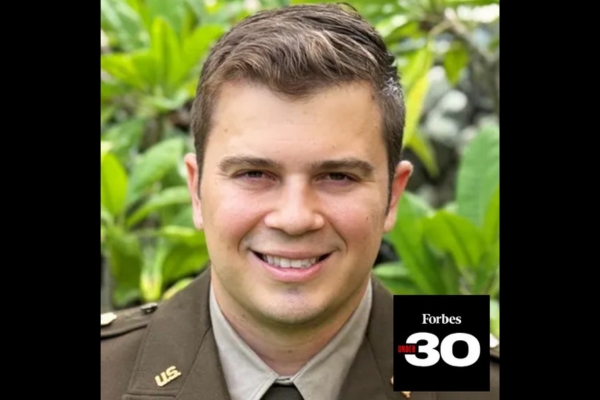

West Point graduate and Tripler Army Medical Center resident CPT Bradley Pierce ’18 was recognized by Forbes “30 Under 30” in Healthcare for developing field-ready medical technologies that bridge the gap between engineering and combat casualty care.
When Uniformed Services University of the Health Sciences (USU) alumnus Pierce began medical school after graduating from the United States Military Academy at West Point in 2018, he brought with him a fascination with engineering, problem-solving, and the possibility of improving trauma care through technology. By the time he graduated from USU in 2022, that fascination had matured into a passion for improving patient care which has allowed him to create a prolific portfolio of medical innovations, each aimed at solving real-world clinical challenges encountered in both military and civilian settings. Today, as a General Surgery resident at Tripler Army Medical Center (TAMC), Pierce continues to advance the same mission he began as a medical student: leading interdisciplinary teams to develop field-ready, life-saving medical technologies for the most challenging environments.
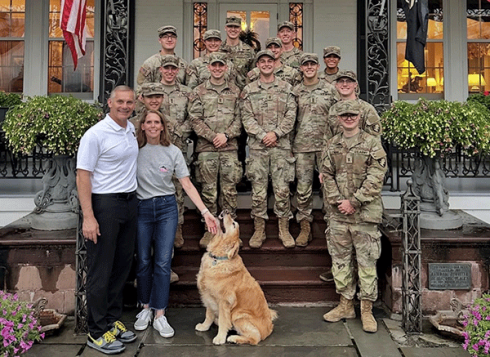
Pierce’s early innovation work took shape at USU, where he co-founded the Medical Innovations Interest Group (MI2G), a student-led initiative designed to encourage medical students to identify gaps in care and develop tangible solutions. One of the group’s early accomplishments, which Pierce helped drive along with classmate Josephine Pucci, was the development of a bubble bilevel positive airway pressure (BiPAP) system. Rather than relying on hospital-grade ventilatory equipment, the team created a novel bubble BiPAP device built around the simple principle of adjusting water depth to tailor pressure delivery. The design allowed for non-invasive ventilatory support in resource-limited environments and was flexible enough to be adapted for both pediatric and adult patients. He led the initial development and testing of this prototype with Cadets from West Point who were interested in a career in military medicine. Pierce later advanced this concept into a formal patent application with the help of the U.S. Army Medical Research and Development Command, marking one of his earliest protected inventions and illustrating the blend of biomedical engineering and clinical insight that would define much of his later work.
His most widely recognized innovation, however, emerged in his fourth year of medical school. While studying the physiology of trauma, Pierce became acutely aware of a persistent and deadly problem: hypothermia in trauma patients, especially those experiencing prolonged evacuation or treatment delays. Traditional warming methods—blankets, insulation, body heat transfer—often prove insufficient in austere environments. Recognizing the need for an active warming solution, Pierce partnered with classmate Ryan Stevens and faculty mentor Maj. (Dr.) Laura Tilley to develop the System for Thermogenic Emergency Airway Management (STEAM), a compact, battery-powered device that warms and humidifies inhaled air delivered through standard ventilation equipment.
STEAM works by transforming the airway into a heat-exchange interface, allowing medics to leverage the lungs’ natural surface area to transfer warmth back to the patient. The system includes safety features such as automated temperature regulation, sensor-driven airflow control, and sterilizable components designed for repeated use in the field. Pierce and his team secured institutional support to apply for international patent protection on the device, marking the first student-led patent application in USU’s history. He continues to lead the development of this device, having partnered with a medical/engineering design firm to secure federal funding for its advanced development, which was recently submitted to the FDA for regulatory feedback. His work on STEAM became a model for what student-led innovation could accomplish and highlighted the potential for simple, field-appropriate technologies to address complex clinical problems. The initial prototyping supplies provided by USU’s Capstone Research Program for STEAM formed the basis of the MI2G MakerSpace, which has continued to expand thanks to the ongoing effort of MI2G medical student innovators.
Following STEAM, Pierce expanded his innovation portfolio to include a range of devices targeting surgical, traumatic, and infectious disease challenges. He is currently working on developing an adjustable multi-arm surgical retractor designed to improve exposure during mastectomies and other procedures involving large tissue flaps by integrating illumination and smoke evacuation to improve visualization and reduce operative strain. In the realm of infection control, he is developing a flexible, LED-based violet-blue visible light sterilization system capable of delivering light-driven antimicrobial energy without the safety hazards associated with ultraviolet systems.
Most recently, Pierce is working on technologies aimed at wound healing and surgical efficiency. His preloaded suture device for hernia repair offers surgeons a mechanism for rapidly deploying sutures, an innovation intended to simplify an operative technique. He also designed a trimmable, silicone-embedded photobiomodulation wound therapy dressing capable of delivering therapeutic light while maintaining thermal regulation, a feature particularly valuable in complex or irregular wound surfaces.
One of his most technically ambitious projects, the System for Prolonged Intravascular Resuscitation in Trauma (SPIRIT), tackles the devastating problem of noncompressible torso hemorrhage—an injury pattern with extremely high mortality rates. Inspired by prior transplant surgery literature showing how doctors can keep room temperature preservation fluid flowing to certain organs during donation after the heart stops, he is developing a system that integrates extracorporeal membrane oxygenation (ECMO) and continuous renal replacement therapy to support patients undergoing aortic or vena cava occlusion during severe internal bleeding to slow the damage caused by loss of blood flow–especially when life-saving surgery can’t be done right away. His research has been submitted for publication and is currently under review, and early results suggest that even small pediatric-sized tubes placed in peripheral blood vessels may deliver enough blood flow to the lower body to safely extend the time a major artery can be blocked.
The overall aim of this work is to develop a system that overcomes the current operational challenges of prehospital ECMO utilization by having a compact, low-flow system to reduce the risk, cost, and logistical barriers associated with this technology. Pierce hopes that a system like this could also benefit patients undergoing planned procedures with a high risk of hemorrhage to help mitigate uncontrolled bleeding such as invasive tumor resections or postpartum hemorrhage. This breakthrough innovation was cited in the recent announcement of his selection to the prestigious Forbes “30 Under 30” Healthcare list for 2026, which highlighted his work developing life support technologies.
Taken together, Pierce’s seven patent filings—spanning respiratory support, hypothermia prevention, surgical tools, resuscitation technology, sterilization, and wound healing—represent a level of innovation rarely seen so early in a physician’s career. More importantly, each invention is grounded in a practical, real-world need observed in trauma bays, operating rooms, and battlefield medical settings. His approach reflects a broader vision: that medical innovation should be accessible, adaptable, and capable of functioning where resources are scarce and the stakes are highest.
As Pierce continues his surgical residency, his dual identity as a clinician and engineer continues to drive his work. Every day in the operating room and trauma service offers new insights into the unmet needs of frontline care—and new opportunities to create the tools that will address them. His selection to the Forbes “30 Under 30” Healthcare list is a recognition not only of his achievements to date, but of the tremendous potential ahead as he continues to blend scientific creativity, clinical expertise, and a commitment to improving survival for the most critically injured.
In a world where conflict, natural disasters, and resource limitations continue to challenge medical systems, innovators like Dr. Bradley Pierce represent the future of trauma care: physicians who do not simply use the tools they are given, but design the tools that are missing.