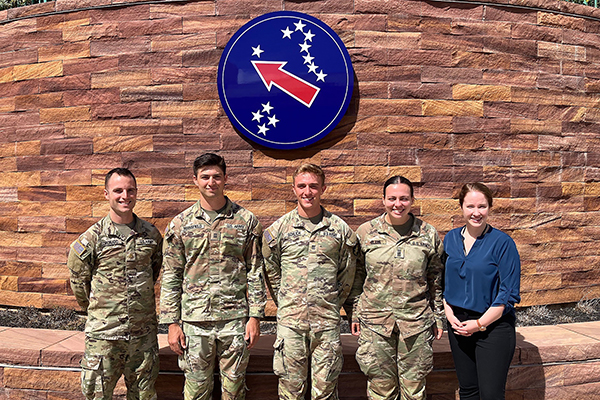
This summer, West Point cadets stepped out of the classroom and into one of the world’s most strategically vital regions, the Indo-Pacific. Working alongside U.S. Army Pacific (USARPAC) units and partners across locations like South Korea, Japan, Singapore, and Hawaii, cadets contributed to real-world military challenges, reinforcing the Academy’s 2025-26 academic theme: “Projecting Lethality: Addressing the Multidimensional Challenges in the Indo-Pacific.”
Through the Academic Individual Advanced Development (AIAD) program, cadets gained exposure to U.S. military operations, strategy, and partner engagement in the Pacific. Among the standout experiences were two projects focused on data-driven innovation: a modernization effort at the Joint Pacific Multinational Readiness Center (JPMRC) and a coding initiative to support information analysis at USARPAC.
Class of 2026 CDTs Tyler Gohlich and Zac Mansfield worked as exercise controllers at JPMRC in Hawaii, where they helped modernize JPMRC’s casualty data process, making it more accurate and responsive during training exercises. The goal is to rapidly advance this yearlong cadet capstone project and deploy the cadet team to the theater in November to support pilot implementation during JPMRC Rotation 26-01 in Hawaii.
“These AIADs give cadets a rare look at the staff functions that make our Army the most professionally run military in the world,” said LTC Dan Koban ’04, assistant professor in the Department of Systems Engineering (DSE). “Through these experiences, cadets are honing their ability to engage with stakeholders, solve complex challenges, and communicate with senior leaders.”
Former DSE faculty member and current data analyst in USARPAC’s Chief Data Office, MAJ Nick Coronato ’12, discussed the mutual benefit of the cadets being placed in USARPAC’s Chief Data Office in Hawaii: “In three weeks’ time, cadets received an immense amount of exposure to systems and processes … (and) our USARPAC staff used the cadets’ work to inject academic rigor into our problem-solving approaches.”
Since 2021, USARPAC’s Chief Data Office has partnered with DSE to apply cadet and faculty talent to real-world problems in the Indo-Pacific. This year, CDT Cecilia Ollis ’26 developed a Python code to help USARPAC process and apply information to support operational planning and decision-making.
“CDTs Ollis, Mansfield, and Gohlich left a tremendous impression across the USARPAC staff during their short time here,” Coronato said. “It was remarkable to see the energy, talent and academic rigor they applied to decomposing the problems of data capture at the Joint Pacific Multinational Readiness Center.”
Gohlich said that working with various operational groups offered a glimpse into how different leaders, facing different challenges, interacted to accomplish a common mission.
“We visited the Theater Fires Detachment, which approves fires across the Pacific to employ resources effectively and inflict the most damage,” he explained. “We were working closely with the 196th Infantry Brigade to improve the way that they collect scenario-based casualty data.”
Gohlich also highlighted the mentorship from his sponsor.
“Seeing MAJ Coronato’s ability to unite his team — people with experience in different fields and sometimes of higher rank — to solve a problem, helped me learn how to form an effective team,” Gohlich stated.
Mansfield found that working with a four-star headquarters was an invaluable experience. With the 1st Theater Information Advantage Detachment, he learned about the Army’s synchronization efforts to combat adversaries’ influence in the Indo-Pacific.
“It was extremely rewarding to be working on a project that has real-world impact on training for our operational units,” Mansfield said. “I was proud of the progress we made while there, but I won’t be satisfied until our product is in operation at JPMRC and receiving positive user feedback.”
Out-of-classroom experiences like this are made possible by generous donors who support the Margin of Excellence.
The excerpt and image were taken from https://www.westpoint.edu.