
By Jane Anderson, Editorial Manager
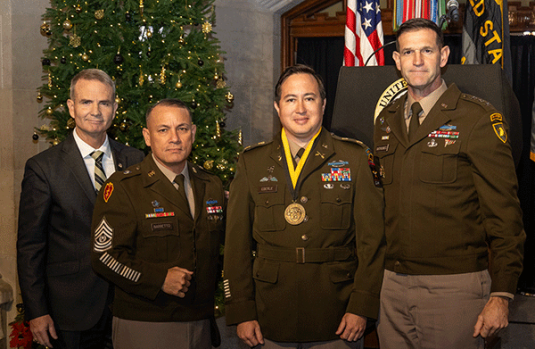
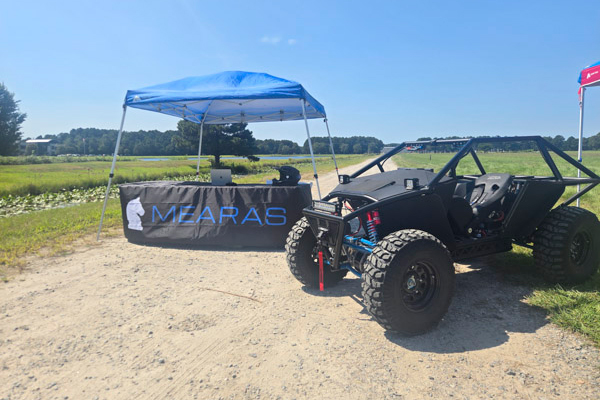
Justin McCarty ’09’s ethos has embodied leadership since he first tried applying to West Point as a precocious sixth-grader. Once he joined the Academy after high school graduation, it helped provide the confidence and character that sparked his post-military success at Tesla and solidified his entrepreneurial leap into founding the automotive company Mearas and launching Athena, a remotely operated, electrified all-terrain vehicle.
“I’m honored to be a part of the Long Gray Line, knowing that I’m a part of something greater than myself,” McCarty says. “And I think that camaraderie, that knowledge of self and that grounding, is what then allowed me to have the confidence to put myself out there as an entrepreneur.”
Growing up in Manhattan, McCarty was a student of history and became acclimated to the U.S. Military Academy at West Point via family car rides up the Palisades Parkway and around the Academy’s Gothic architecture. He decided early in his life that USMA was at the top of his post-high-school list. “When I took my SATs in the sixth grade, I decided that I wanted to have an application open,” McCarty recalls. He honed his leadership in high school, organizing paintball events that attracted 50-plus players at a time, so McCarty knew that his college choice would entail more than strict academics.
The 9/11 terror attacks that occurred while McCarty was a freshman in high school sealed his decision. “I knew I was going to join the military,” he says. “I also had started the enlistment process for the Marine Corps, but West Point was the only college application I actually completed.” Disappointing the Marine Corps recruiter was a small price to pay to launch McCarty’s USMA journey.
“What West Point really taught me was perseverance and shaping my character, and the grit that’s required for entrepreneurship,” he says. “And when those foundational pieces come together, you become someone that other people want to follow, and they want to build something with you.”
In 2009, McCarty commissioned as a second lieutenant into Field Artillery. His graduating class was among those graduating from the Academy into combat for the Global War on Terror. Mosul, Iraq was McCarty’s first deployment in 2010-2011after the Basic Officer Leader Course, as a Combat Observation and Lasing Team leader with 1st Squadron, 9th Cavalry Regiment, the reconnaissance squadron of the 4th Brigade, “Long Knife,” 1st Cavalry Division, during the transition from Operation Iraqi Freedom to Operation New Dawn. He then moved to Joint Base Lewis-McChord, WA, deployed through the Pacific on Pacific Pathways (Thailand, the Philippines and Korea), and commanded an M777-towed howitzer battery for about two years.
In 2013–2014, McCarty deployed to Afghanistan with the 2nd Brigade, 1st Cavalry Division. He was the assistant operations officer (Assistant S3) before becoming a task force platoon leader, and pinned captain.
“I did lots of dismounted patrols, looking for things, and it drove into me my ‘why,’” he says. “The next house we clear might be the last one I ever do; the next route I clear might be the last route I ever go down.”
But the knowledge that his purpose was aligned with something greater than himself gave him courage—and that perspective also eventually drove him to found Mearas.
“I think that courage applies to entrepreneurship as well,” McCarty relates. “I believe what I’m doing is going to work, but it’s under the full knowledge that the real possibility is that it won’t. That’s not because I wasn’t good at it, and it’s not because I’m a bad person: It’s just it’s a part of the process, the risk of it all.”
McCarty saw the Army transition from Bradley vehicles, armored Humvees, and various other heavy platforms in Iraq to the Mine-Resistant Ambush Protected All-Terrain Vehicle (M-ATV)—a heavily armored tactical wheeled vehicle that was more mobile but still tough to maneuver—in Afghanistan.
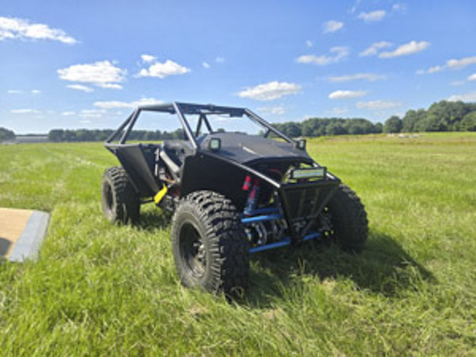
“Simultaneously, I watched special operations roll up in unarmored two-seat vehicles,” he recalls. The smaller vehicles’ freedom and maneuverability on the battlefield were in stark contrast to the others, and they made an impression on McCarty.
“A Caterpillar diesel overseas is a unique sound you can hear in the middle of nowhere, so you’re not sneaking up on anybody,” he says. “But these smaller, gas-powered vehicles are quieter, your signature is reduced, and you also can drive on more roads.”
He knew there was a need for a vehicle like Athena shortly after his Afghanistan deployment, and working at Tesla convinced him it had to be electric. That burned in McCarty’s mind throughout his 10-year military career and continued as he transitioned out of the Army. “That was the hardest decision of my professional career, was to finally walk away,” McCarty says. “But at that point, I’d counted the days, literally, I was home.” McCarty and his wife, fellow ’09 graduate Lieutenant Colonel Kimberly (Schultz) McCarty, had two children by then and he had only been home for a total of six months over the span of two years.
An admirer of entrepreneurs like Thomas Edison and Henry Ford from a young age, McCarty felt his calling was within the automotive sector, and he joined Tesla. He worked on one of the lighting projects for the Shanghai factory, then took over the hand-tools supply contract and pricing with their supplier across all plants. Soon, McCarty was one of the first members of the team that evolved into the Optimus program. The rocket-speed trajectory was exciting, but it came at a price.
“My wife had just gotten orders to West Point to be the assistant G4, and I was living in California and commuting back and forth between the two to see my wife and kids,” he says. “After leaving the Army because I didn’t see my wife and kids, I found myself as a civilian literally chasing the mighty dollar instead of the selfless service I learned at West Point, and I felt like a massive hypocrite.”
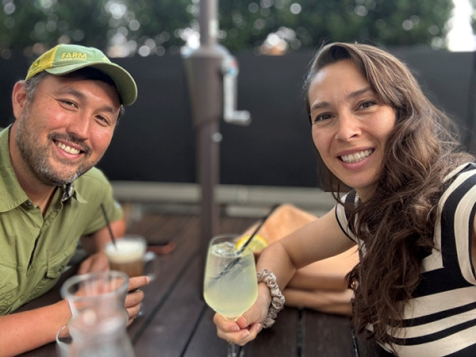
So, McCarty quit before Christmas in 2019 and joined his family in New York. When the COVID-19 pandemic hit, McCarty took care of their pre-K and kindergarten-age kids…and he and Kimberly welcomed a third child. In 2021, McCarty worked in operations for Polestar and enrolled at the Columbia Business School.
While there, he took a mandatory class in entrepreneurship. In class, McCarty scribbled out on a whiteboard a business plan for an automotive company and a rough design of his idea for a remotely operated military vehicle.
“My professor said, ‘You’ve got this founder energy; you should do this,’” McCarty explains. “So I started working on it and then launched the company in June 2025.”
A WPAOG-sponsored entrepreneur summit in Manhattan was the first place McCarty pitched his business. “I met a bunch of people there, and those connections have persisted to today,” McCarty says. “Their advice and their mentorship have been of great value to me, to just be a sounding board.”
The second Athena prototype is in the design-build process, with plans to produce a 400-horsepower vehicle. At the 2026 West Point Entrepreneur Summit, a couple lucky visitors were able to buzz around behind Eisenhower Hall in the driver’s seat of the first prototype, controlling its movements and speed with a converted XBOX game controller.
The vehicle’s name was inspired by West Point and by the patron goddess of Athens herself. “Pairing war with wisdom can feel contradictory, until you realize that strength limited by virtue and principle is what breeds justice and peace; that fits Mearas’s dual-use character,” McCarty explains.
Looking back on his entrepreneurial career so far, McCarty would like to advise potential founders to persist. “Sometimes you can just be unlucky, and it doesn’t mean anything about you or your ability or your capability; it just didn’t work out, and don’t blame yourself,” he says. “But if it’s something that you really are passionate about, then try again.”
West Point’s values have guided McCarty as well. “My focus is on the success of the business, but not at the expense of principles, including my dedication to my wife and family,” McCarty says. “Duty, Honor, Country is what drives character. They can’t be just slogans, otherwise we dilute what it means to be a part of the Long Gray Line.
“That requires sacrifice and it can make things harder,” McCarty concludes. “But there’s no other way.”