
By Jane Anderson, WPAOG Staff
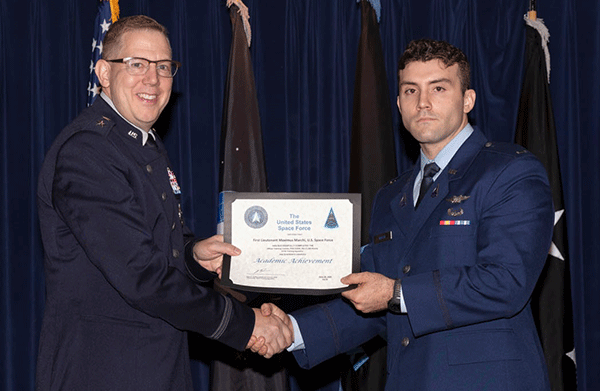
The United States Space Force, the sixth and newest branch of the U.S. Armed Forces, was established on December 20, 2019. The following summer, Maximus Marchi entered the U.S. Military Academy—and graduated four years later as the first West Point cadet to commission as a second lieutenant in the Space Force, along with two other classmates, Nathon Segovia and David Sang.
“Space Force exists because space is a warfighting domain,” Marchi says. As a Guardian in the 5th Space Launch Squadron of Space Launch Delta 45, Marchi provides mission support for Vulcan, Falcon, and New Glenn launch vehicles on a team that manages a $6.2 million budget.
“The 5th SLS exists to provide mission assurance for national security launch vehicles and spacecraft operations at the launch site. Essentially, we make sure every box is checked before the rocket goes up,” Marchi explains. “We have a lot of oversight on a launch because, although it may be SpaceX or another provider launching the rocket, the payload that sits in the rocket has an asset that can provide national security capabilities for the U.S.”
The 5th Space Launch Squadron has supported launches for GPS, ISR, PNT, and satellite communication payloads that the military relies on, Marchi says: “So that’s why we care that these companies like SpaceX or Blue Origin can launch rockets. They have the best ways to get into space, and we, as a military, need to get into space so we can provide capabilities to the warfighter.”
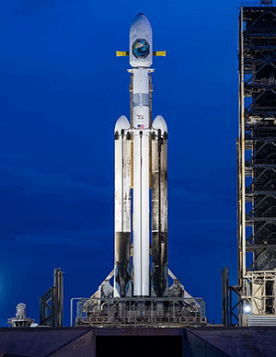
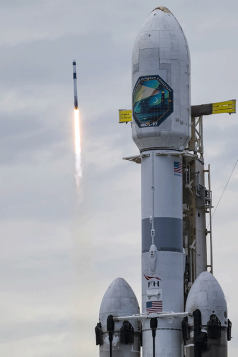
Marchi explained his role with Space Force a day after the National Reconnaissance Office, in partnership with U.S. Space Force Space Systems Command’s System Delta 80, Space Launch Delta 45, and SpaceX, successfully launched the NROL-97 mission on October 1 from Launch Complex 39A at NASA’s Kennedy Space Center. During launches like that, Marchi and his fellow mission-support Guardians—or “green suiters,” as they’re called—are expected to provide their independent assessments of launch processing to ensure everything goes smoothly.
“You’d be surprised how many times green suiters are able to catch small mistakes, and we’re able to prevent what they call anomalies—instances when something goes wrong during launch,” Marchi says.
There is a tremendous amount of responsibility associated with mission support. “The nature of the operation being something that you know is going to impact the warfighter and impact our nation’s ability to defend itself brings a little bit more gravity and ownership to your operations,” Marchi says. “It’s a serious responsibility: Before that rocket goes up, we need to identify the risks, help address the problems and make sure decision-makers understand where we stand. The warfighter is counting on that capability.”
Marchi has always had an interest in space, and he was able to flex that a bit while a cadet at West Point. As a plebe, Marchi was a member of the hypersonics rocket team of West Point’s Space Engineering and Applied Research-Army Rocketry & Engineering Sciences (SPEAR-ARES), a research line of effort supported by the Physics & Nuclear Engineering Department at USMA. As a team member, Marchi coordinated moving the rocket from West Point to White Sands, NM, for the launch.
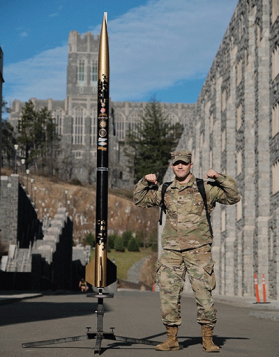
“I had to get all these hazmat clearances through for us to be able to transport the rocket and the propellant from West Point to White Sands,” he says. “I didn’t handle launching the rocket, but I was mission support. So that’s what I did at the Academy when I was on the hypersonics rocket team, and that’s kind of what I’m doing now.”
Marchi rose in the ranks and became the cadet in charge of SPEAR. He was also a member of West Point’s first NASA student launch team. In 2023, the team built a rocket that they launched in the NASA Student Launch Competition. Competing against other service academies and colleges, the West Point team earned a first-place victory in two award categories: the Service Academy award and the Rookie Award.
The Space Force sparked an interest for Marchi about halfway through his cadet journey, and a few devastating injuries solidified that option. Upon graduation, Marchi’s medical résumé included three ACL tears and a femur reconstruction. While at the Academy, Marchi “felt personally motivated to go and do hard things and be the kind of soldier you dream about when you are a little boy. Be that present leader who makes a difference.” Marchi further noted, “As I learned more about space and ailments began piling up, I began to see how I could carry that same commitment into a different warfighting domain.”
Still wanting to be as close to the fight as possible and impact the future of this nation’s defense capabilities as best as he possibly could, Marchi did some soul-searching and decided to pursue the Space Force: “Considering the tough decisions that were before me with respect to my injuries and the talents I had, I thought I was going to be best suited to a career in the Space Force. I think that was my way of being able to continue the dream of protecting and defending the American people to my greatest ability. That is what needs to motivate you to pursue any branch, whether it be armor, field artillery, or logistics. Think: What is my skill set and how will the American people benefit from it?”
As one of the first West Point cadets to pursue this commissioning path, Marchi presented his goals to the Inter-Service Commissioning Board. “West Point taught me to think seriously about where I could make the greatest contribution,” he says. “When I went before the board, I wanted to explain how my experiences at the Academy had prepared me to serve and why I believed I could contribute to the mission of the Space Force.”
As he gained experience as a Guardian, the connection between his work and the joint force became even clearer. “Every time I see a national security launch go up, I remember that it’s carrying a critical asset for a soldier that’s downrange on the front line, maybe in a foxhole or in a bunker somewhere, that our nation’s men and women rely on for their forward operations.”
Marchi projects that—with experience—he will be able to take on a more hands-on mission assurance role. For now, he’s amazed at every launch in which he’s taken part. The Falcon Heavy that launched on October 1 had five million pounds of thrust, which was impressive to see in person, he says. Even more astonishing is watching the side boosters detach and steer themselves through the atmosphere to land back on landing zones.
The complexity and hazards inherent in working with propellants and rockets underscore the importance of disciplined engineering and risk management. The 5th Space Launch Squadron operates in the former Range Control Center at Cape Canaveral Space Force Station in Florida. Completed in 1951, the RCC served as the central control point for Eastern Range launch support until March 1995, overseeing approximately 3,000 missile and space launches, including Space Shuttle and Titan IV missions.
“Working in this incredibly historic site is a constant reminder of the responsibility that comes with space launch,” Marchi says. “It brings that sense of gravity to what we do. When you walk through it every day, you remember that our work contributes to capabilities that people’s lives depend on. Mission assurance means applying those lessons and maintaining the discipline to identify and reduce risk.”
Space Force’s responsibility to help protect the American people is reflected in the capabilities it delivers to the joint force—and Marchi doesn’t take that lightly. Satellites provide navigation, secure communications, missile warning and intelligence that help military forces recognize threats, coordinate operations and defend the nation. The 5th SLS contributes by providing mission assurance and integrating the efforts of the agencies and launch partners involved in a National Security Space Launch. “There are so many moving parts, but it is really an incredibly orchestrated operation,” he says. “The goal is bigger than getting a rocket off the pad. It’s helping deliver the capabilities that our warfighters need to accomplish their missions and protect the American people.”
The Space Force was a good choice for Marchi, and he encourages other cadets to pursue their future careers with a clear sense of service and purpose. “Whether it be Air Defense, Artillery, Infantry, Armor, Quartermaster, Logistics, Aviation, or even the Space Force, the most important thing that a cadet needs to consider is that they are making sure that they’re putting themselves in the best position to support the fight,” Marchi says. “That’s why I ended up in the Space Force, not because I knew that it was a convenient thing for me or because I knew that I was going to have a grand time—but because I knew that space would be the decisive point of our country’s next conflict.”
Marchi can’t predict where the Space Force will take him next. For now, he simply loves what he is able to do. “I feel like I am as close to the fight as anybody is,” he concludes. “I joined West Point because I wanted to impact the fight, and I wanted to do the best I could for my nation and leave my mark in helping protect and defend this country.”